
The Daily iQ

What Collision IQ learned, one numbered and sourced entry per day. Every fact here was verified the day it was filed into the platform's knowledge base, so the platform argues from the industry's own documents and numbers. Sources and cards open in a new tab.

Latest entry: #34 · Saturday, Oct 17, 2026

Entry #34Law & regulation

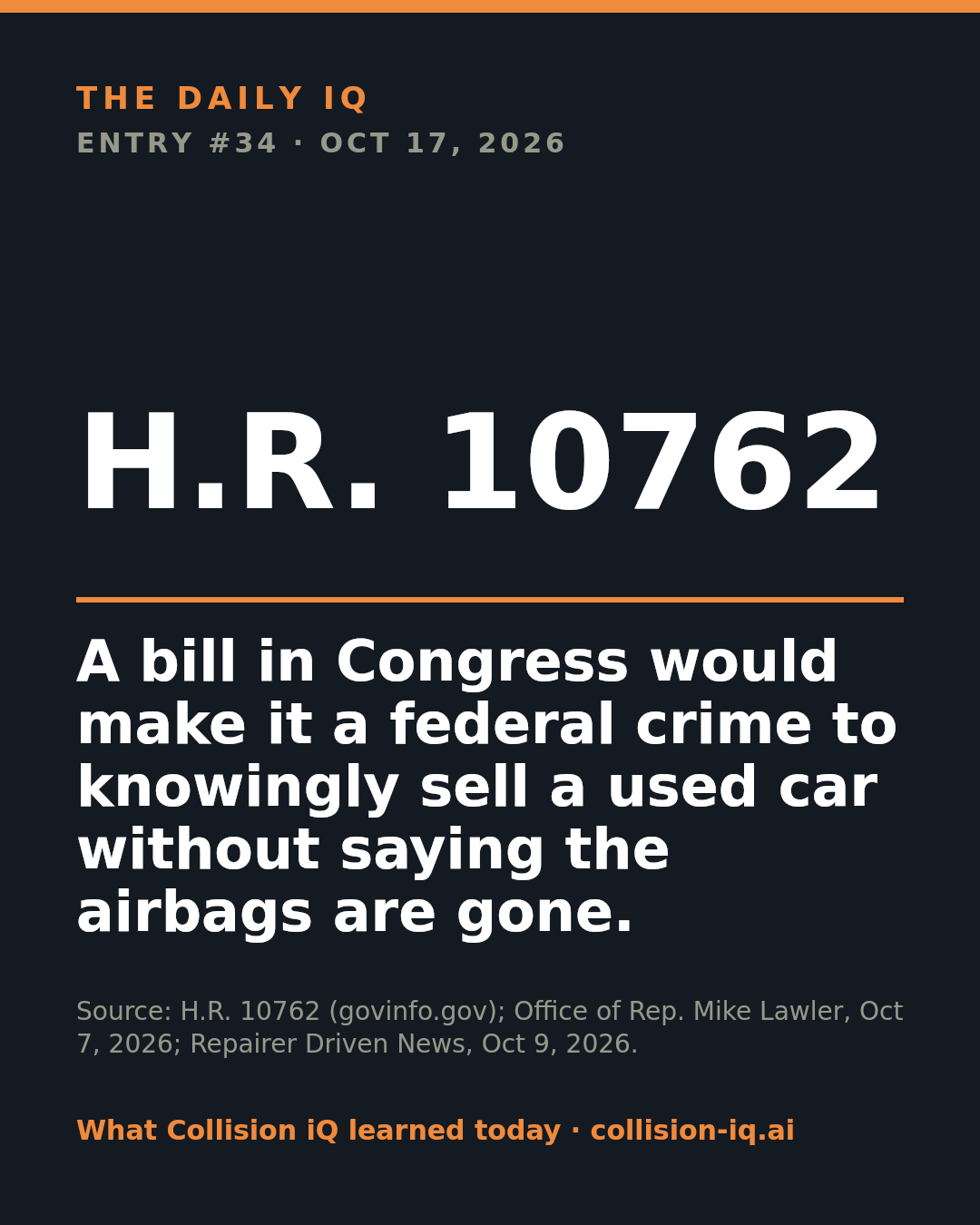
A bill in Congress would make it a federal crime to knowingly sell a used car without saying the airbags are gone.

H.R. 10762Anthony Amoros Law Right to Know Act, introduced in the U.S. House October 6, 2026

Introduced in the U.S. House on October 6, 2026 by Rep. Mike Lawler of New York, H.R. 10762 — the Anthony Amoros Law Right to Know Act — would require that a used vehicle sold through an auction, dealership, individual, or other resale channel either have a functional airbag system or the seller clearly disclose that the airbag system is missing or disabled. The bill text adds a new federal criminal offense for knowingly selling such a vehicle without disclosure, with prison terms that rise if serious injury or death results, and makes violations an unfair or deceptive practice enforceable by the FTC and state attorneys general. It is named for a Rockland County man who died in a crash in a car sold to him without airbags, without his knowledge.

The collision-industry part of the story: airbags are often among the most expensive lines on a severe hit, which makes them a tempting line to skip when a totaled car is rebuilt for resale. A deployed airbag that was never replaced is invisible from the driver's seat. It shows up in the repair paperwork — and in a post-repair inspection, which exists for exactly this.

Why it matters

It's a proposed bill, not law. But it names the failure precisely: a missing airbag is a paperwork question first, and a buyer of a previously damaged car is entitled to ask it.

How Collision iQ uses it

Filed into the knowledge base as the pending federal disclosure reference behind Collision iQ's post-repair inspection and restraint-system checks.

Sources — open in a new tab
#usedcars#airbag#carsafety#totalloss#collisionrepair
The Daily iQ entry 34 card: H.R. 10762, the Anthony Amoros Law Right to Know Act, would require used-car sellers to disclose missing or disabled airbags.

Share card · opens in a new tab
Entry #33Insurance industry data

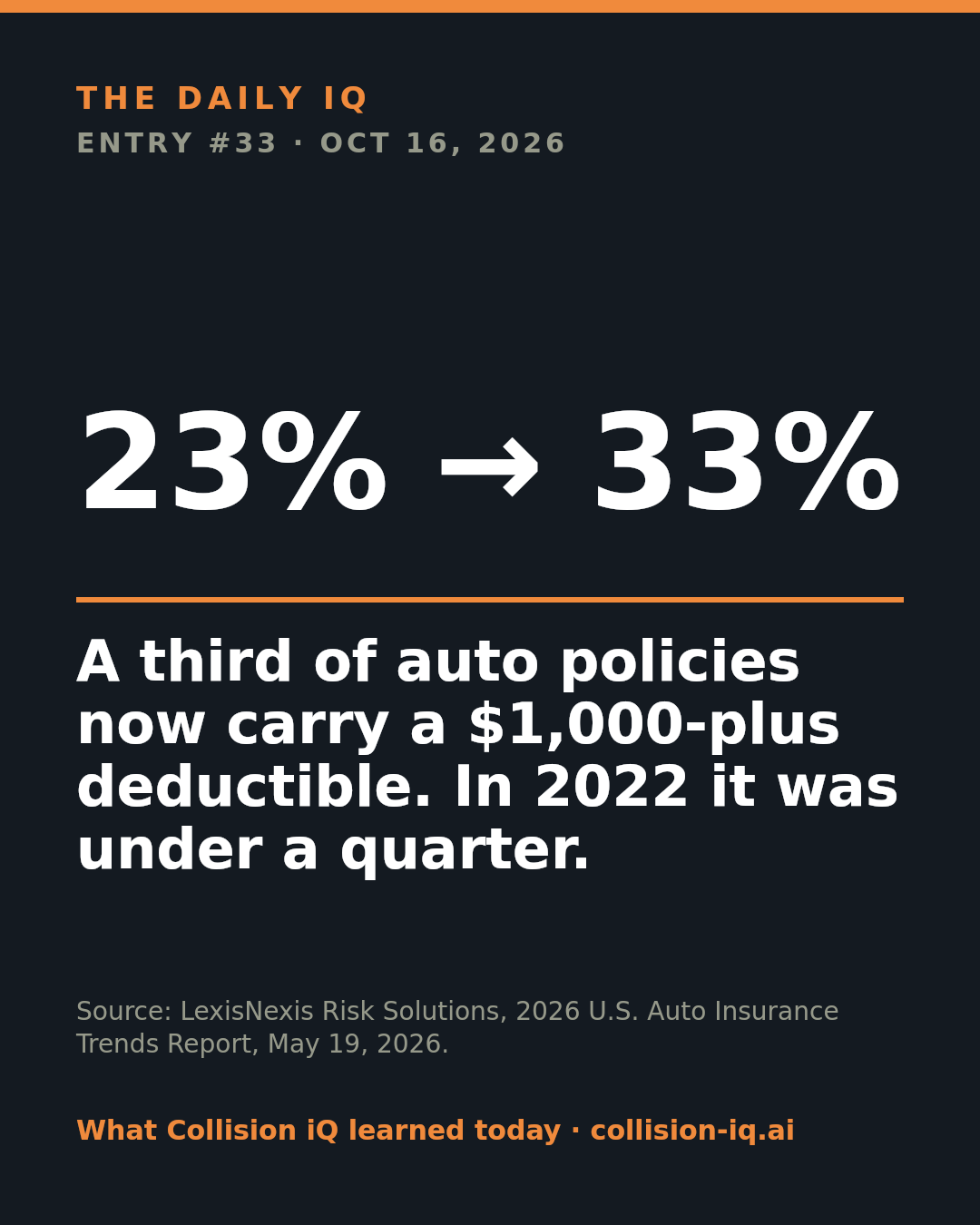
A third of auto policies now carry a $1,000-plus deductible. In 2022 it was under a quarter.

23% → 33%share of auto policies with deductibles of $1,000 or more, 2022 to 2025, per the 2026 LexisNexis U.S. Auto Insurance Trends Report

LexisNexis Risk Solutions' 2026 U.S. Auto Insurance Trends Report (May 19, 2026) found the share of policies with deductibles of $1,000 or greater rose from 23% in 2022 to 33% in 2025. Same report: policy shopping hit historic highs in Q4 2025, with more than 47% of policies in force shopped at least once in the previous 12 months.

What that means in a claim: the higher the deductible, the more of the repair conversation is happening with the owner's own money. A declined line on a $1,000-deductible claim isn't an abstraction — the owner is already a thousand dollars in before the first disagreement starts.

Why it matters

The paperwork standard doesn't change with the deductible. The stakes of reading it did.

How Collision iQ uses it

Filed into the knowledge base as the dated consumer-exposure reference behind Collision iQ's plain-English explanations of what an estimate's numbers mean to the owner.

#carinsurance#deductible#insuranceclaim#autoinsurance#caraccident
The Daily iQ entry 33 card: auto policies with $1,000-plus deductibles rose from 23% in 2022 to 33% in 2025.

Share card · opens in a new tab
Entry #32OEM position statements

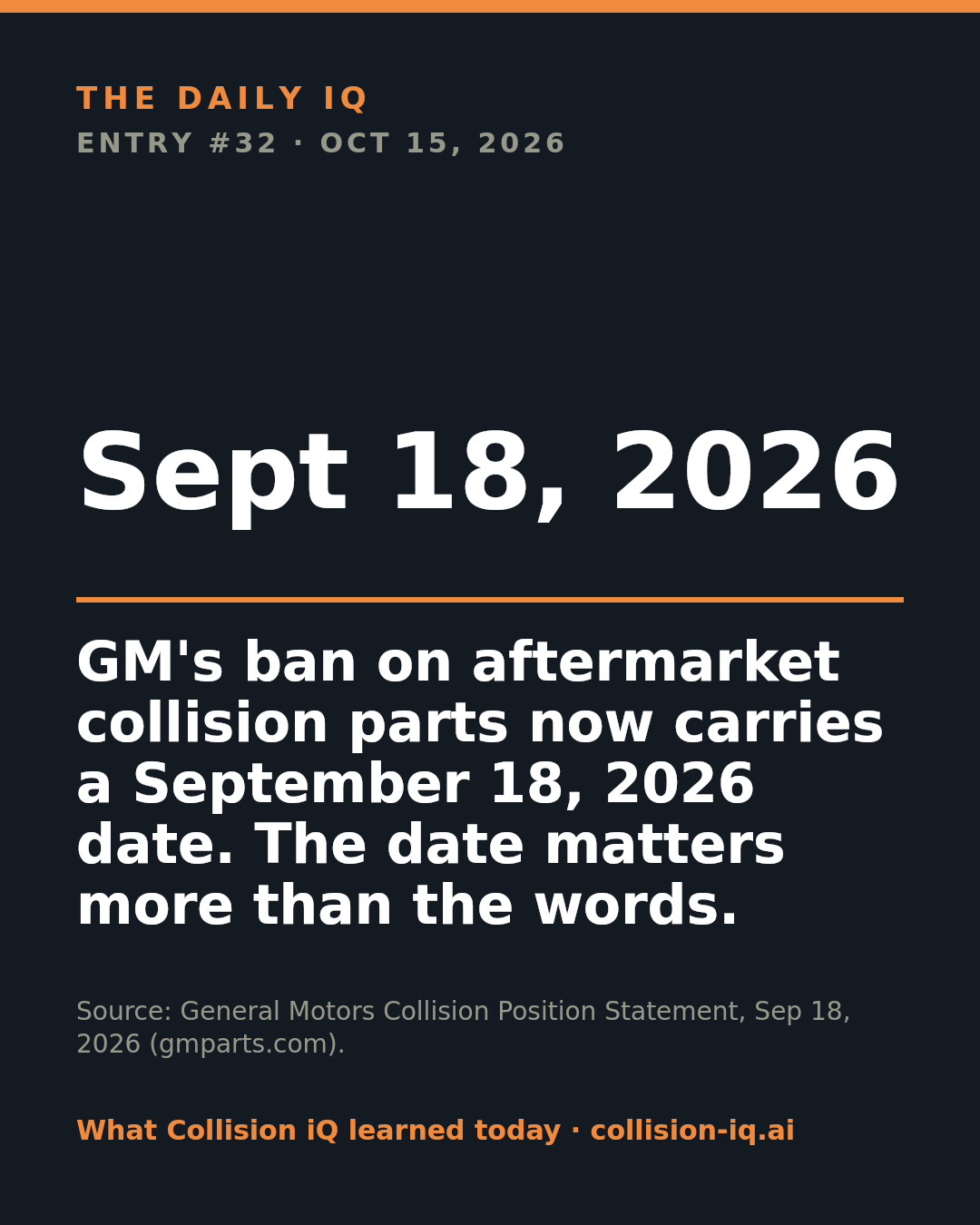
GM's ban on aftermarket collision parts now carries a September 18, 2026 date. The date matters more than the words.

Sept 18, 2026date on GM's current Collision Position Statement, "Use of Genuine GM Original Equipment Parts"

GM's Collision Position Statement on the use of genuine GM parts now carries a September 18, 2026 date. It reads: "GM strictly prohibits the use of non-GM approved salvage, recycled/used, or non Genuine aftermarket parts on Chevrolet, Buick, GMC, and Cadillac vehicles." It requires that collision, structural, and system-dependent repairs use GM OE parts and GM-approved procedures, and states that damage, failure, or non-performance arising from non-GM parts is not covered under the GM New Vehicle Limited Warranty or GM service plans.

The "strictly prohibits" language itself isn't new — Repairer Driven News reported GM adding it on July 30, 2026. What's new is the current date on the document. In an estimate dispute, the first pushback against a position statement is often "that's outdated"; a statement dated September 18, 2026 answers that before it's asked.

Why it matters

OEM position statements are dated authority. When an estimate on a GM vehicle substitutes a non-OEM part, the counter-document now carries a current date.

How Collision iQ uses it

Filed into the knowledge base as the current GM parts position statement the OEM authority pipeline cites when an estimate lists aftermarket, recycled, or salvage parts on a GM vehicle.

#oemparts#collisionrepair#aftermarketparts#chevrolet#insuranceclaim
The Daily iQ entry 32 card: GM's Collision Position Statement prohibiting non-GM aftermarket, recycled and salvage parts, dated September 18, 2026.

Share card · opens in a new tab
Entry #31Law & regulation

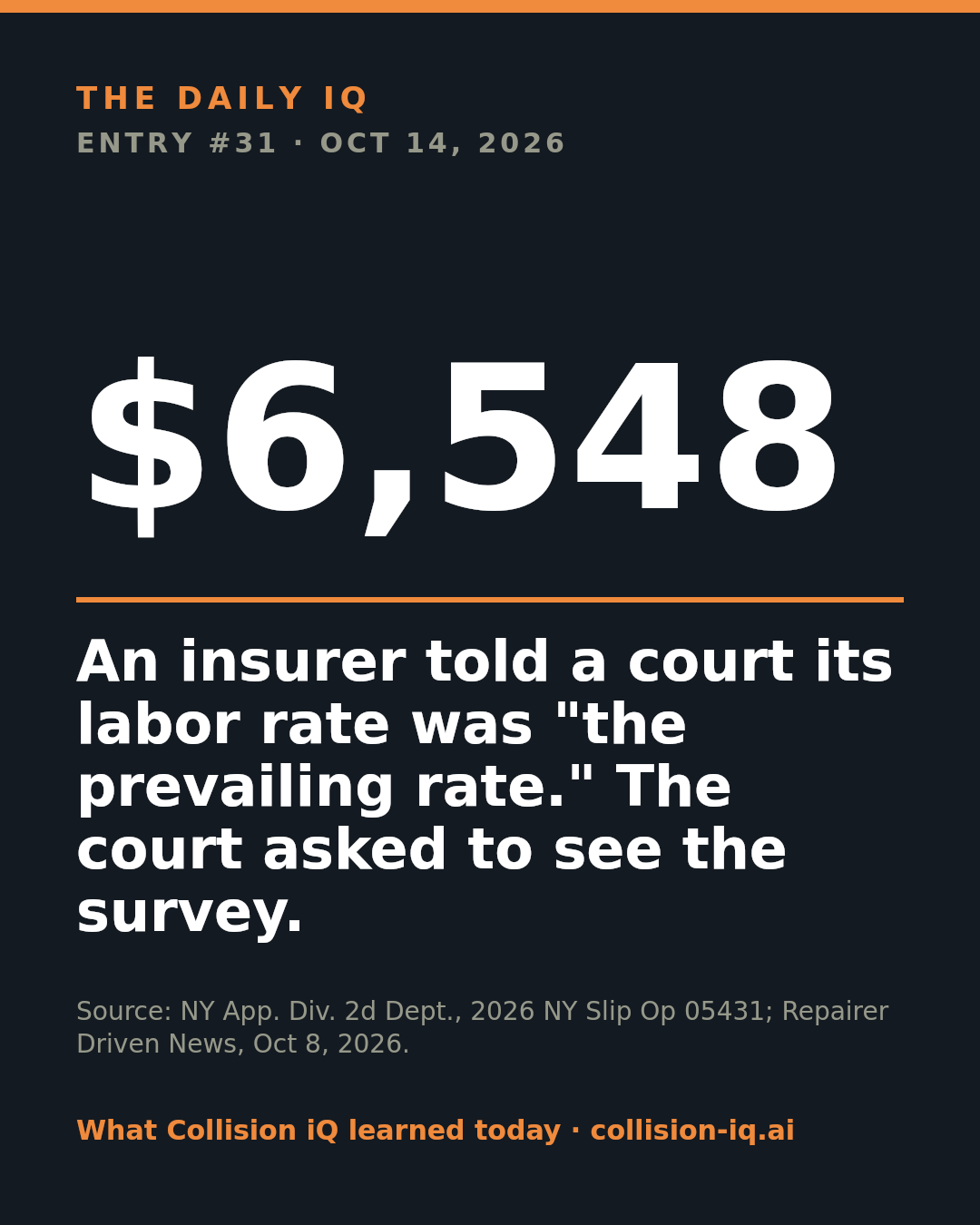
An insurer told a court its labor rate was "the prevailing rate." The court asked to see the survey.

$6,548gap between $19,736.60 billed and $13,188.22 paid on a 2018 Audi Q7 repair — Prospect Auto Sales & Repairs v. State Farm, NY Appellate Division, Second Department, Sept 23, 2026

A New York repair shop, suing as the owner's assignee, sued State Farm for breach of contract over a 2018 Audi Q7 repair: $19,736.60 billed, $13,188.22 paid. State Farm said it paid based on its own estimate written at the prevailing competitive rate, as determined by a survey it prepared. On September 23, 2026, the Appellate Division, Second Department — New York's intermediate appeals court — reversed the dismissal and revived the suit. The court called the prevailing-rate defense "wholly conclusory and unsubstantiated, as the defendant never furnished the survey it purported to rely upon."

To be precise about what happened: the shop hasn't won anything yet. The case goes back to be litigated. What the court said is narrower and more useful — a rate isn't "prevailing" because someone says so. It's prevailing if there's a document.

Why it matters

"Prevailing rate" is a claim, and this court treated it like one: a rate assertion without the survey behind it didn't carry the insurer's burden.

How Collision iQ uses it

Filed into the knowledge base as the New York case reference behind Collision iQ's labor-rate review: every rate traces to a printed page, or it is flagged as unsupported.

Sources — open in a new tab
#insuranceclaim#autobodyrepair#laborrate#collisionrepair#courtruling
The Daily iQ entry 31 card: a $6,548 gap between $19,736 billed and $13,188 paid; a New York appeals court revived the suit because the insurer's rate survey was never produced.

Share card · opens in a new tab
Entry #30Law & regulation

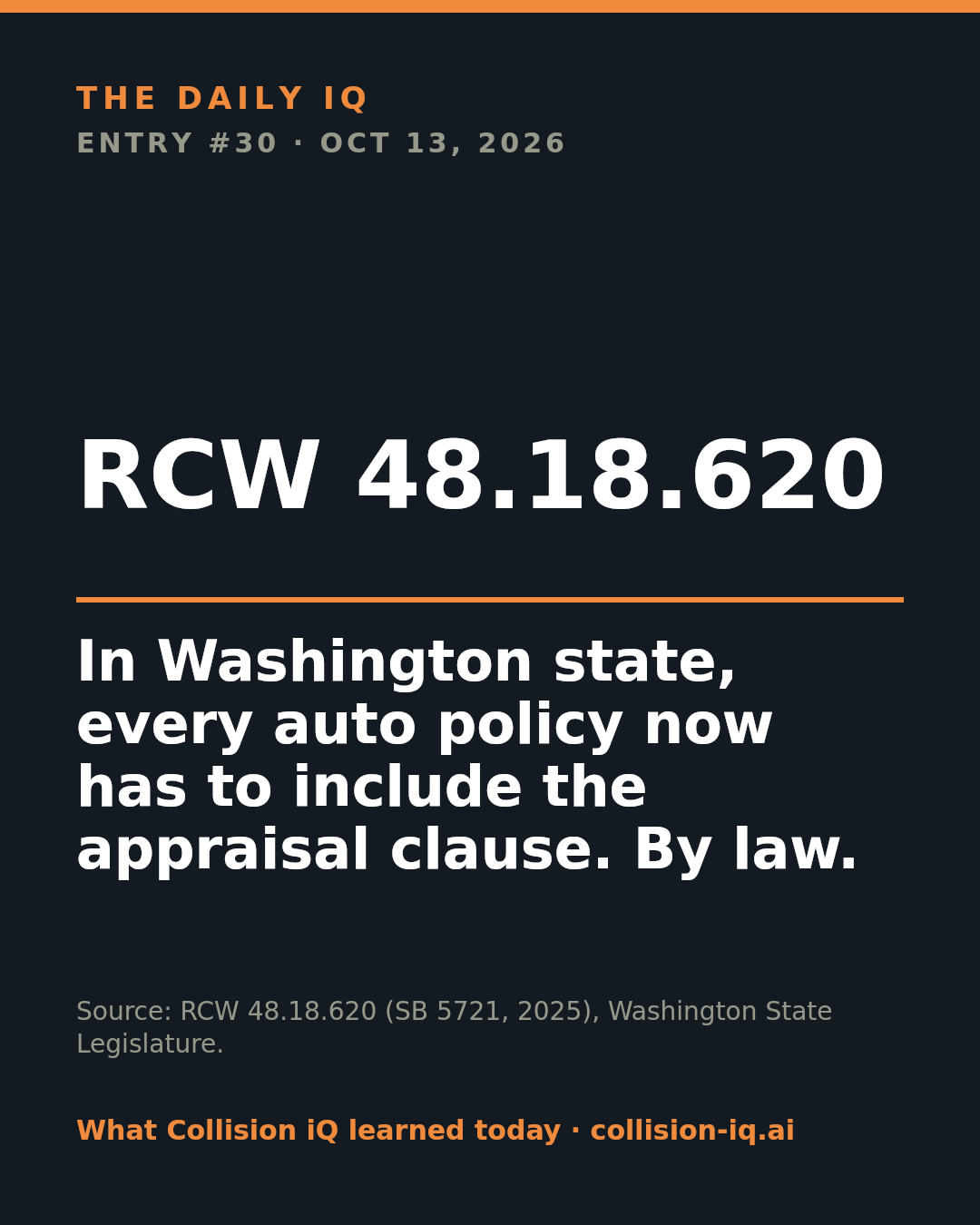
In Washington state, every auto policy now has to include the appraisal clause. By law.

RCW 48.18.620Washington statute requiring an appraisal provision in auto policies with first-party physical damage coverage issued or renewed on or after January 1, 2026

Washington's RCW 48.18.620, enacted by Senate Bill 5721 (signed May 20, 2025), requires an appraisal provision in every auto policy with first-party physical damage coverage issued or renewed effective on or after January 1, 2026. If the policyholder and insurer can't agree on the amount of loss, either side can demand appraisal in writing. Each picks a competent and disinterested appraiser within 10 days; appraisals are due within 30 calendar days; the appraisers select an umpire, and an agreement of any two of the three is binding. Each side pays its own appraiser and the umpire's cost is split equally.

Most states leave that clause to the policy form. Washington wrote the mechanism into statute, deadlines included.

Why it matters

When appraisal is a statutory right with fixed deadlines, a valuation dispute has a defined path to a binding second opinion — and a policyholder can point to the statute, not just the policy.

How Collision iQ uses it

Filed into the knowledge base as the Washington reference in the state-by-state appraisal-rights record Collision iQ cites in dispute guidance.

Sources — open in a new tab
#insuranceclaim#appraisalclause#knowyourrights#caraccident#washingtonstate
The Daily iQ entry 30 card: Washington RCW 48.18.620 requires an appraisal clause in auto policies issued or renewed on or after January 1, 2026.

Share card · opens in a new tab
Entry #29Repair economics

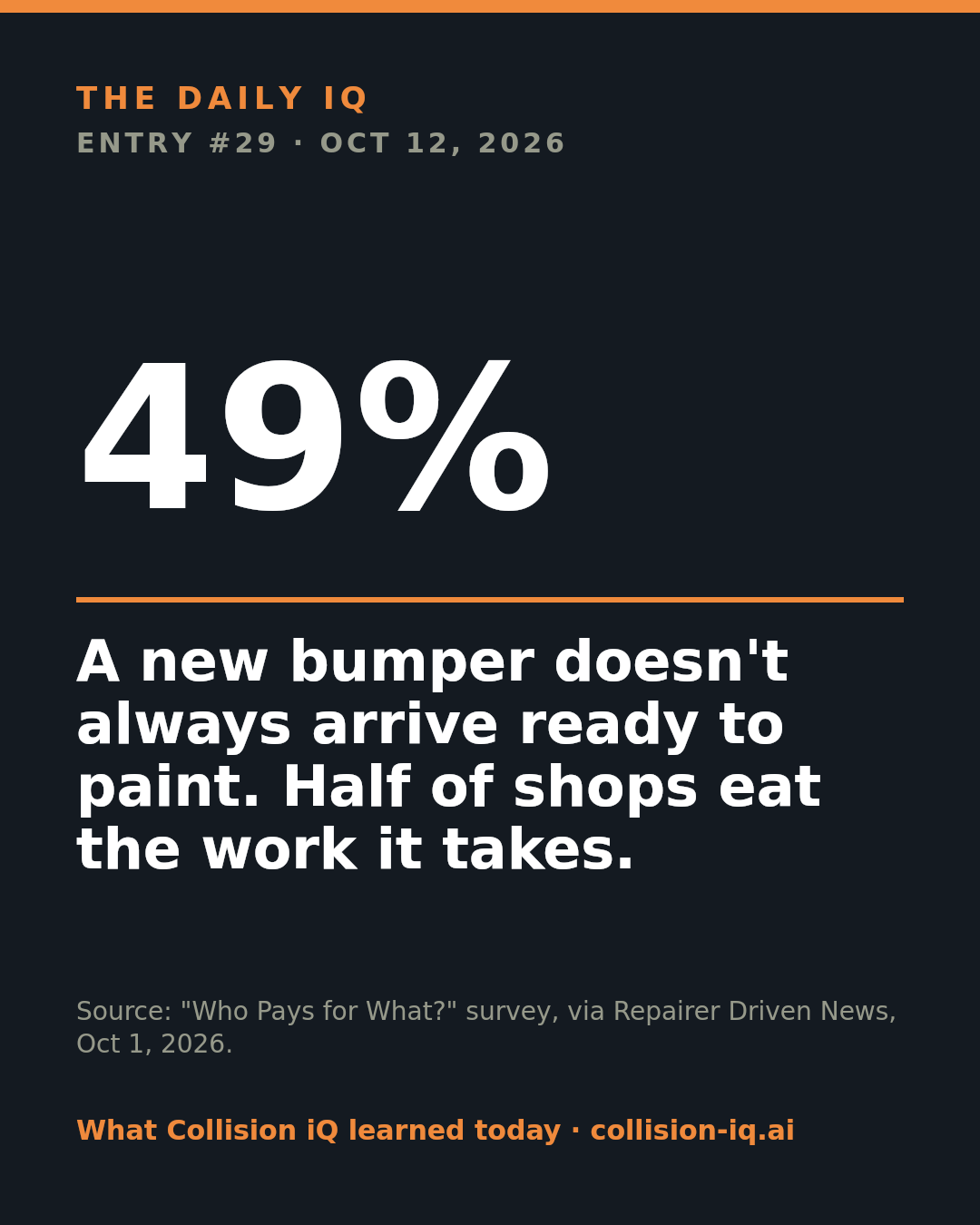
A new bumper doesn't always arrive ready to paint. Half of shops eat the work it takes.

49%share of shops that have never charged for repairing molding or manufacturing defects on new replacement bumpers, per the latest "Who Pays for What?" survey

New replacement bumpers can arrive with molding or manufacturing defects — casting lines or shipping braces that have to be trimmed before the part can be prepped and refinished. That labor is real work with no automatic line on the estimate.

The latest "Who Pays for What?" survey, reported by Repairer Driven News and FenderBender on October 1, 2026, found 49% of shops have never included a charge for it — down 10 percentage points from a year earlier. Among shops that do bill it, just 13% said the eight largest national insurers pay always or most of the time, up only slightly from 10% in 2025.

Why it matters

If it isn't written, it isn't paid — even on a brand-new part. A line for repairing a new bumper's manufacturing defects is a legitimate operation, not padding.

How Collision iQ uses it

Filed into the knowledge base as the industry reference for not-included operations on new replacement parts that an estimate review checks for.

Sources — open in a new tab
#collisionrepair#autobody#insuranceestimate#bodyshop#carrepair
The Daily iQ entry 29 card: 49% of shops have never charged for repairing manufacturing defects on new replacement bumpers.

Share card · opens in a new tab
Entry #28Total loss & valuation

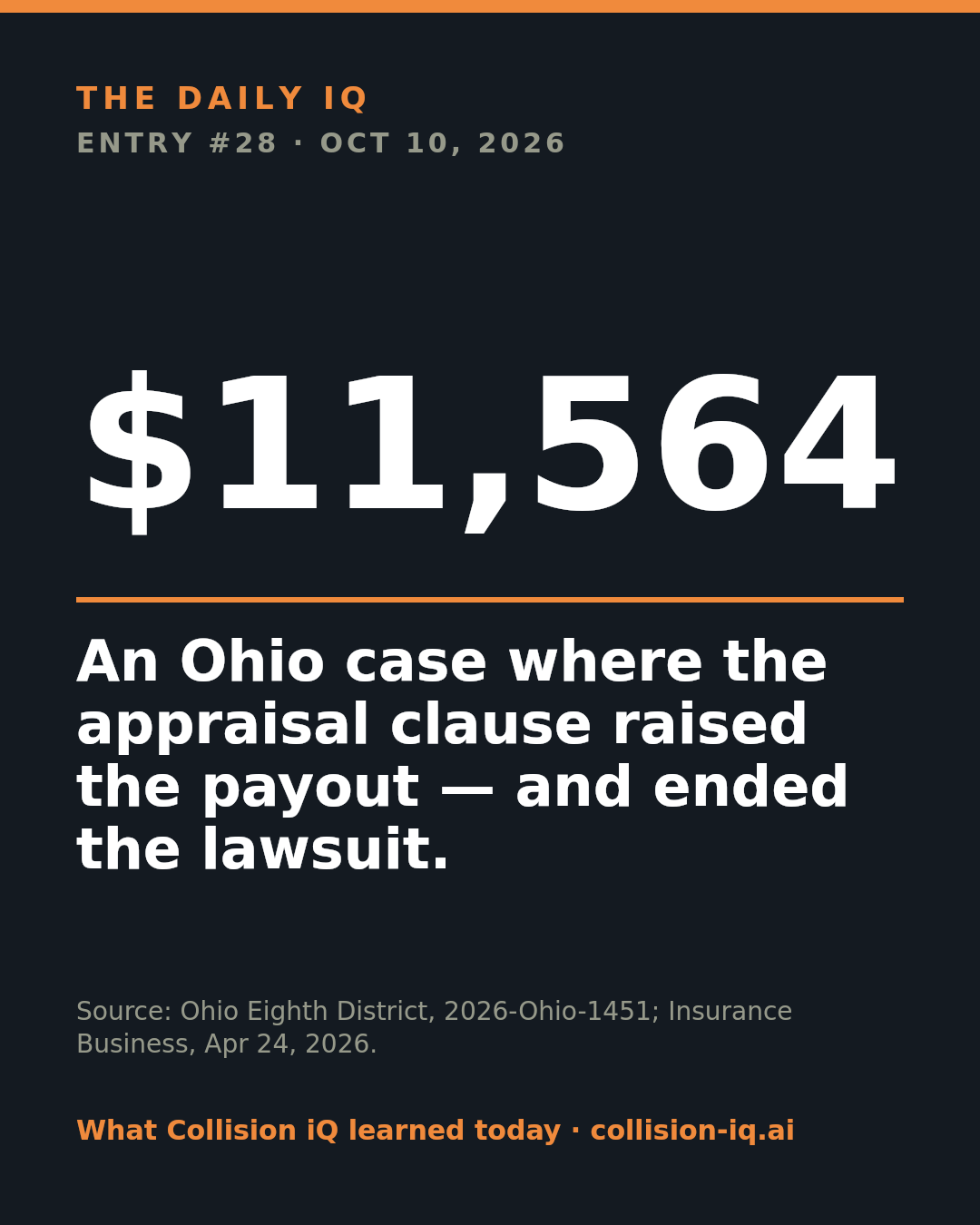
An Ohio case where the appraisal clause raised the payout — and ended the lawsuit.

$11,564appraisal award for a totaled 2008 Honda Element, against the insurer's $10,295 adjusted value — Stewart v. Farmers Ins. of Columbus, 2026-Ohio-1451

In Stewart v. Farmers Ins. of Columbus (Ohio Eighth District Court of Appeals, released April 23, 2026), Farmers valued a totaled 2008 Honda Element at $10,295 after subtracting what the owner called an undisclosed "condition adjustment," and paid $9,795 after his $500 deductible. He sued as a class representative. After the suit was filed, Farmers demanded appraisal under the policy and the trial court compelled it. The two appraisers jointly set actual cash value at $11,564.08 — about $1,269 (roughly 12%) above Farmers' adjusted value — and Farmers tendered a $1,393.29 check for the difference, which he declined to cash.

Then the second half: the appeals court held that because the binding appraisal and the tender resolved his individual claim before class certification, the whole action, class claims included, had to be dismissed. Appraisal moved the number. It also ended the lawsuit — it is an individual remedy that fixes one claim, not everyone's.

Why it matters

The ruling cuts both ways, and both halves are useful: appraisal can raise a total-loss number, and a policyholder weighing appraisal against a broader case should know the one can end the other. The opinion notes the underlying question is pending before the Ohio Supreme Court.

How Collision iQ uses it

Filed into the knowledge base as the Ohio case-law reference behind Value iQ's guidance on appraisal as a total-loss dispute path.

Sources — open in a new tab
#totalloss#appraisalclause#carinsurance#actualcashvalue#insuranceclaim
The Daily iQ entry 28 card: Stewart v. Farmers — appraisal set a totaled Honda Element at $11,564 against a $10,295 adjusted value, and the class action was dismissed.

Share card · opens in a new tab
Entry #27Total loss & valuation

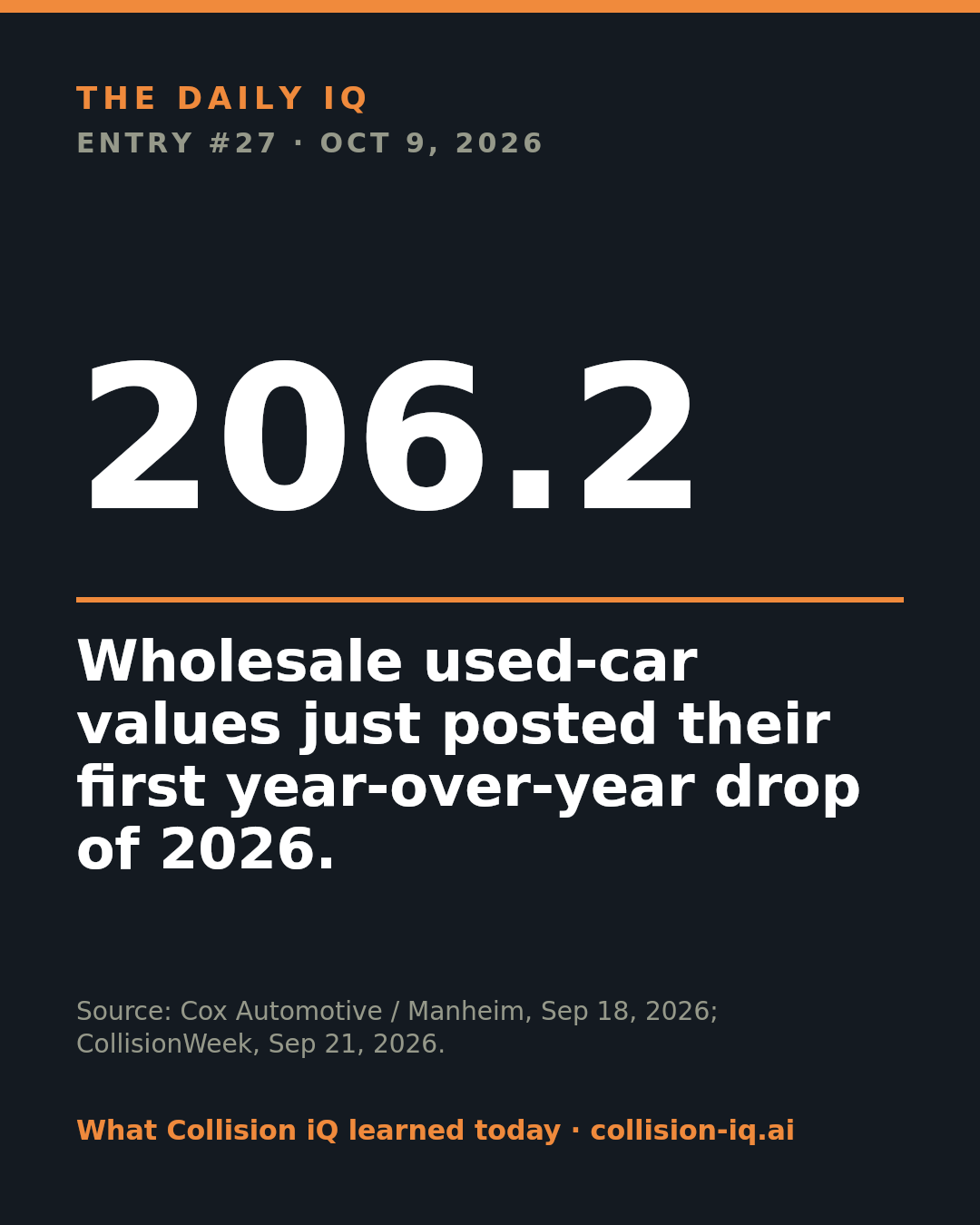
Wholesale used-car values just posted their first year-over-year drop of 2026.

206.2Manheim Used Vehicle Value Index, first half of September 2026 — down 1% from August and 0.4% below September 2025

Cox Automotive's Manheim Used Vehicle Value Index fell to 206.2 over the first 15 days of September 2026 — down 1% from August's 208.2 and down 0.4% from September 2025. Cox's words: the decline was "enough to tip the year-over-year comparison negative for the first time in 2026," per its September 18, 2026 mid-month release and CollisionWeek's September 21 coverage. The full-month reading Cox published October 7 settled at 205.9, down 0.6% year over year.

Wholesale values are the gravity under every total-loss valuation. When the index eases, the actual cash value on settlement paperwork tends to ease with it. What doesn't move automatically is the retail market where an owner actually has to replace the car.

Why it matters

A softening wholesale index is exactly when the comparable vehicles underneath a total-loss valuation deserve a second look — the replacement still has to be bought at retail.

How Collision iQ uses it

Filed into the knowledge base as the dated wholesale-market reference Value iQ reads against a total-loss valuation's comparables.

Sources — open in a new tab
#totalloss#actualcashvalue#usedcarprices#carinsurance#insuranceclaim
The Daily iQ entry 27 card: Manheim Used Vehicle Value Index at 206.2 in mid-September 2026, its first year-over-year decline of 2026.

Share card · opens in a new tab
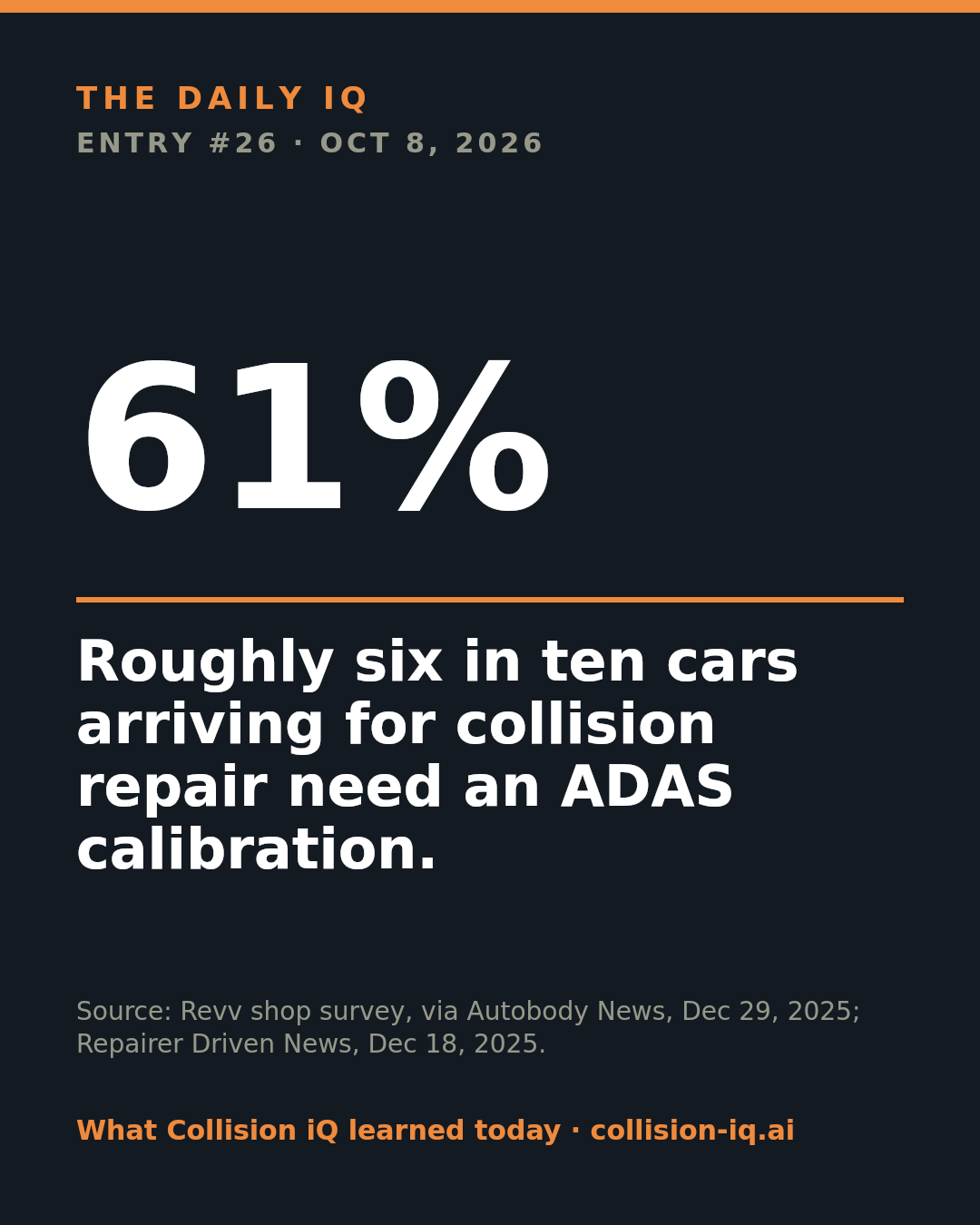
Entry #26ADAS & calibration

Roughly six in ten cars arriving for collision repair need an ADAS calibration.

61%vehicles arriving for collision repair that require some form of ADAS calibration, per Revv's data (survey of 300 shops, October 2025)

Revv surveyed 300 collision and mechanical repair shops across North America in October 2025. Based on Revv's data, roughly 61% of vehicles arriving for collision repair require some form of ADAS calibration, CEO Adi Bathla told Autobody News (December 29, 2025); Repairer Driven News reported the findings December 18, 2025.

Yesterday's entry showed calibration lines on 28.3% of repairable appraisals in 2025 — the share of estimates that include one. Those measure different things, from different sources, but read together they make the same point: a car arriving with camera or radar damage is the common case now, and the paperwork should say what was done about it.

Why it matters

If most cars coming in need a calibration, an estimate on a camera- or radar-equipped vehicle that shows none deserves a written answer about why.

How Collision iQ uses it

Filed into the knowledge base alongside entry #24 as the shop-side calibration-need reference behind Collision iQ's ADAS checks.

Sources — open in a new tab
#adas#adascalibration#collisionrepair#carsafety#insuranceestimate
The Daily iQ entry 26 card: roughly 61% of vehicles arriving for collision repair require an ADAS calibration, per Revv.

Share card · opens in a new tab
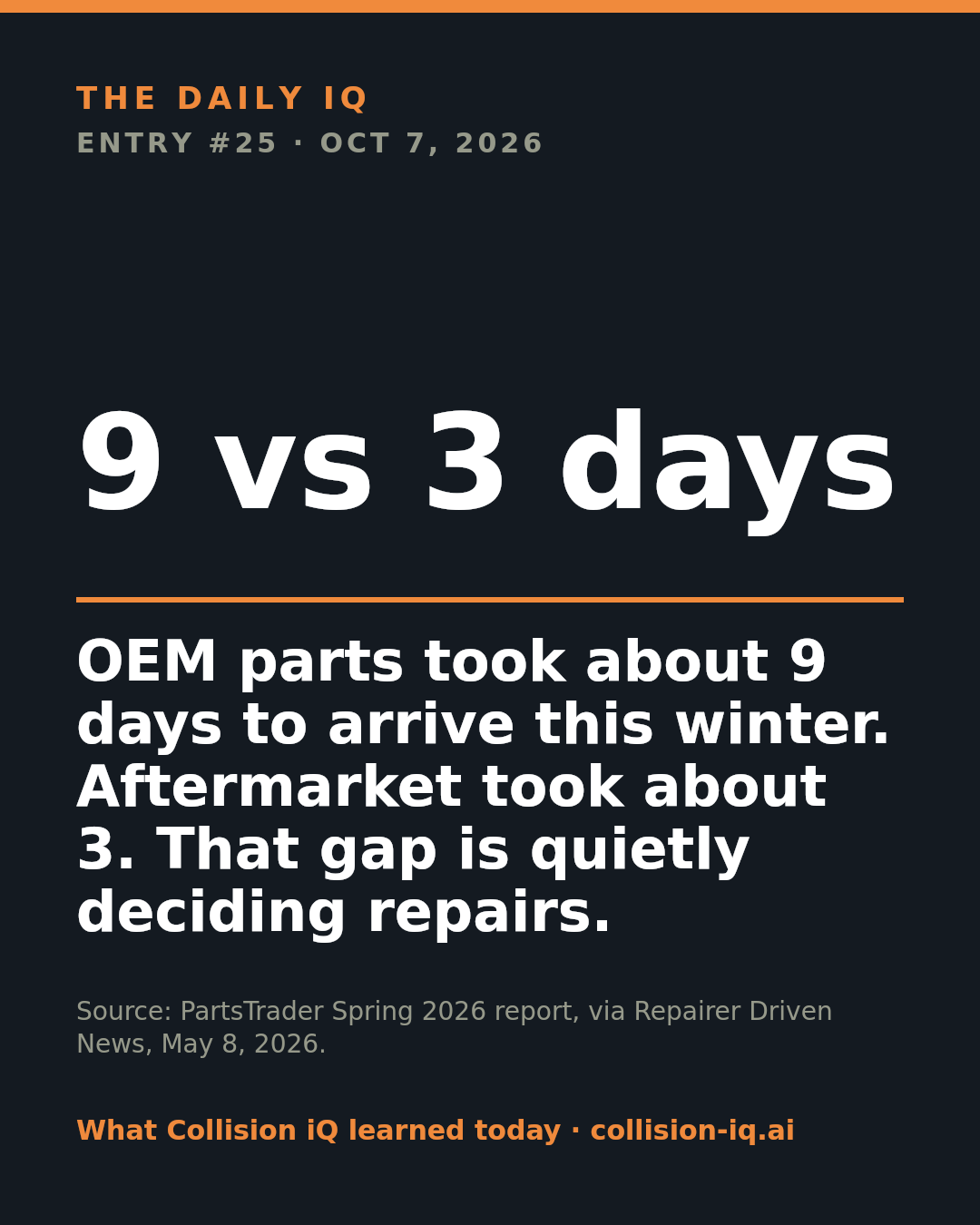
Entry #25Repair economics

OEM parts took about 9 days to arrive this winter. Aftermarket took about 3. That gap is quietly deciding repairs.

9 vs 3 daysOEM vs. aftermarket parts delivery days, January 2026, per PartsTrader's Spring 2026 Collision Industry Report

PartsTrader's Spring 2026 Collision Industry Report, as reported by Repairer Driven News on May 8, 2026, measured OEM parts delivery at 9 days in January and 8.7 in February, driven up by winter storms — against 3.1, 3 and 2.9 days for aftermarket parts in January, February and March. (The metric is median delivery days plus two standard deviations.) The same report found new OEM parts had the largest price increase of any major collision part category, while aftermarket prices stayed essentially flat.

So when two estimates disagree about a part type, they're not just disagreeing about money. They're disagreeing about which week the car gets finished — while the rental meter runs.

Why it matters

A parts substitution moves two clocks: the bill and the cycle time. Worth knowing before anyone says a substitution "doesn't really matter."

How Collision iQ uses it

Filed into the knowledge base as the dated parts-delivery reference Collision iQ reads against part-type differences when comparing two estimates.

Sources — open in a new tab
#autoparts#collisionrepair#oemparts#insuranceclaim#carrepair
The Daily iQ entry 25 card: OEM parts took about 9 days to deliver in January 2026 versus about 3 days for aftermarket.

Share card · opens in a new tab
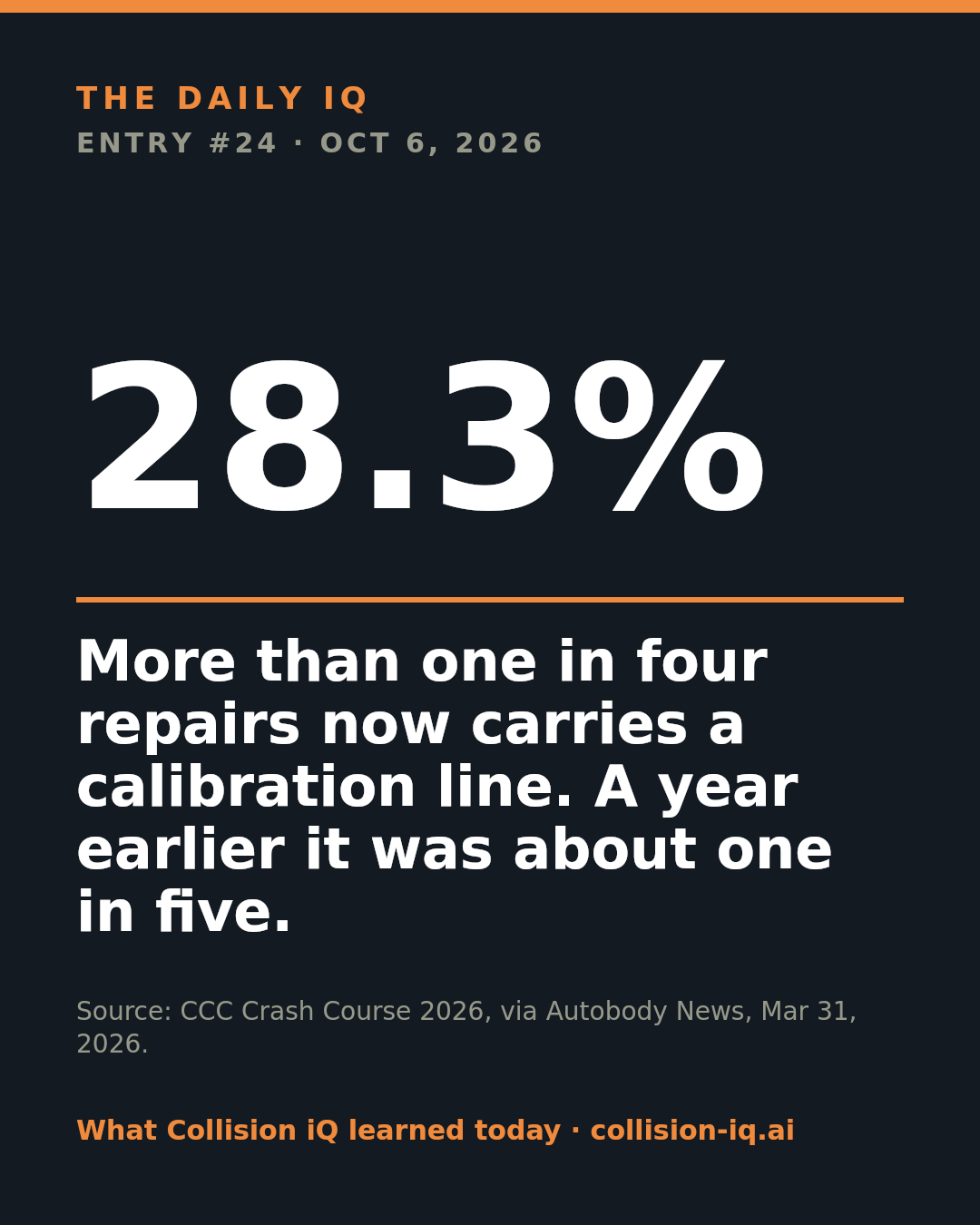
Entry #24ADAS & calibration

More than one in four repairs now carries a calibration line. A year earlier it was about one in five.

28.3%repairable appraisals that included a calibration in 2025, up from 21.8% — CCC Crash Course 2026

CCC Intelligent Solutions' Crash Course 2026 report, "Complexity Compounds" (March 31, 2026), found 28.3% of repairable estimates now include calibrations. Per Autobody News' coverage, that's up from 21.8% the year before — 6.5 percentage points, or a 30% increase in the number of estimates with at least one calibration.

A calibration re-teaches a car's cameras and radar where "straight ahead" is after a repair. The bumper that got replaced probably had a sensor behind it; the windshield that got swapped probably had a camera on it. If a camera or radar was anywhere near the damage and the estimate shows nothing, that's a question worth asking in writing.

Why it matters

On a recent vehicle, the odds that a repair should include a calibration line are climbing every year — a missing one is increasingly the exception worth explaining, not the norm.

How Collision iQ uses it

Filed into the knowledge base as the industry baseline Collision iQ reads an estimate's calibration lines against.

Sources — open in a new tab
#adascalibration#collisionrepair#insuranceestimate#carsafety#insuranceclaim
The Daily iQ entry 24 card: 28.3% of repairable appraisals included a calibration in 2025, up from 21.8%.

Share card · opens in a new tab
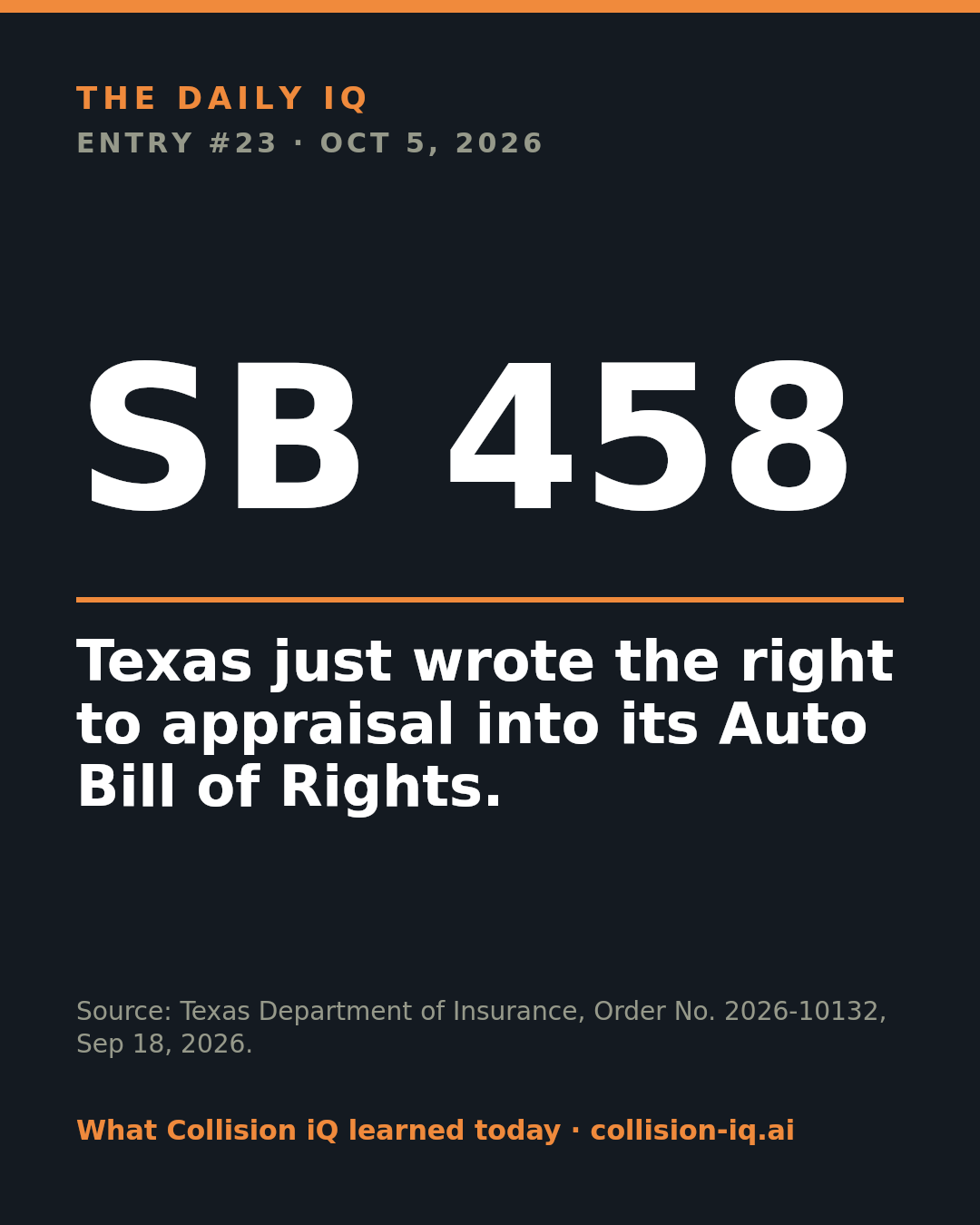
Entry #23Law & regulation

Texas just wrote the right to appraisal into its Auto Bill of Rights.

SB 458Texas law requiring an appraisal provision in personal auto policies issued or renewed on or after January 1, 2026 — now in the state's Auto Bill of Rights (TDI order, Sept 18, 2026)

On September 18, 2026, the Texas Department of Insurance adopted amendments to the Consumer Bill of Rights for personal auto insurance — the plain-language notice insurers must give policyholders. The update reflects SB 458, which created Insurance Code Chapter 1813: personal auto policies delivered, issued or renewed by covered insurers on or after January 1, 2026 must contain an appraisal provision, "a type of dispute resolution process solely to determine the amount of loss when that amount is in dispute between the policyholder and the insurer." The new Bill of Rights line reads: "You or your insurance company have the right to demand appraisal to resolve a dispute about the amount to repair or replace your damaged property."

Insurers must start providing the updated Bill of Rights on January 1, 2027 — TDI moved that date from November 1, 2026 to give insurers lead time. SB 458 itself took effect September 1, 2025. Entry #11 covered the proposal stage of Texas's appraisal-notice rules; this is the part that became official.

Why it matters

In Texas, when the policyholder and insurer disagree on the number, the path to a binding second opinion is guaranteed by statute — and the state now requires that policyholders be told about it.

How Collision iQ uses it

Filed into the knowledge base as the Texas reference in the state-by-state appraisal-rights record Collision iQ cites in dispute guidance.

Sources — open in a new tab
#rightofappraisal#texasinsurance#insuranceclaim#collisionrepair#appraisalclause
The Daily iQ entry 23 card: Texas adds the right to appraisal under SB 458 to its Auto Bill of Rights, adopted September 18, 2026.

Share card · opens in a new tab
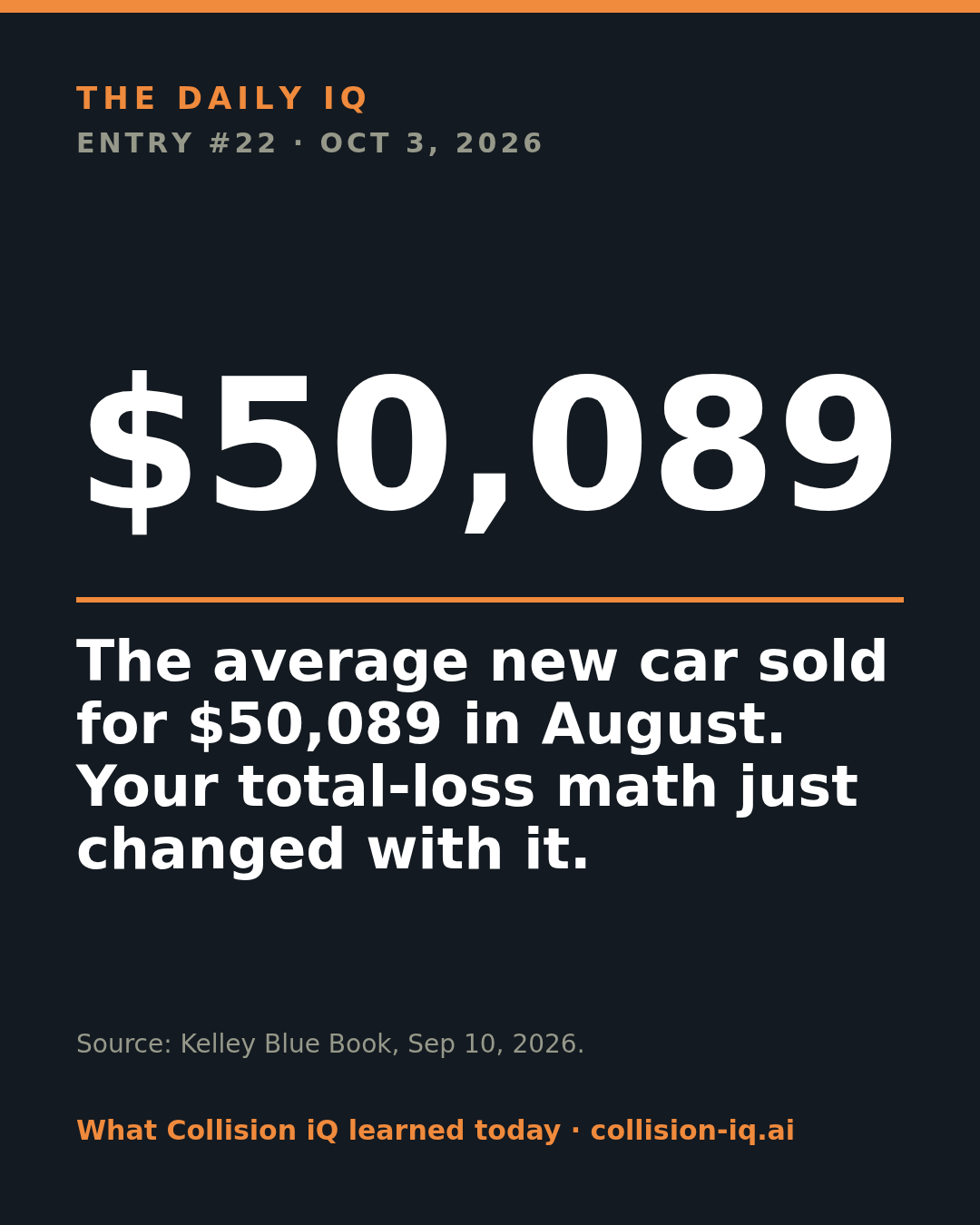
Entry #22Total loss & valuation

The average new car sold for $50,089 in August. Your total-loss math just changed with it.

$50,089average new-vehicle transaction price, August 2026, per Kelley Blue Book — first month this year above $50,000

Kelley Blue Book's August 2026 report puts the average new-vehicle transaction price at $50,089 — up 1.9% from a year earlier and the first month in 2026 above the $50,000 line. EVs averaged $54,813, and their premium over gas vehicles narrowed to 9.4%, from over 16% a year earlier, per Cox Automotive/KBB's September 10, 2026 release.

Higher transaction prices flow straight into claims: actual cash value on newer cars rises, which raises total-loss stakes; repair-versus-total decisions shift; and every percentage point of diminished value is worth more dollars on a $50,000 car than on last decade's $35,000 one.

Why it matters

The size of the check follows the size of the market — a valuation that hasn't kept pace with rising transaction prices is worth checking against current data, not last year's.

How Collision iQ uses it

Filed into the knowledge base as the dated market-price reference Value iQ reads against a total-loss valuation's replacement-cost assumptions.

Sources — open in a new tab
#carprices#totalloss#diminishedvalue#kbb#insuranceclaim
The Daily iQ entry 22 card: average new-vehicle transaction price reaches $50,089 in August 2026, the first month this year above $50,000.

Share card · opens in a new tab
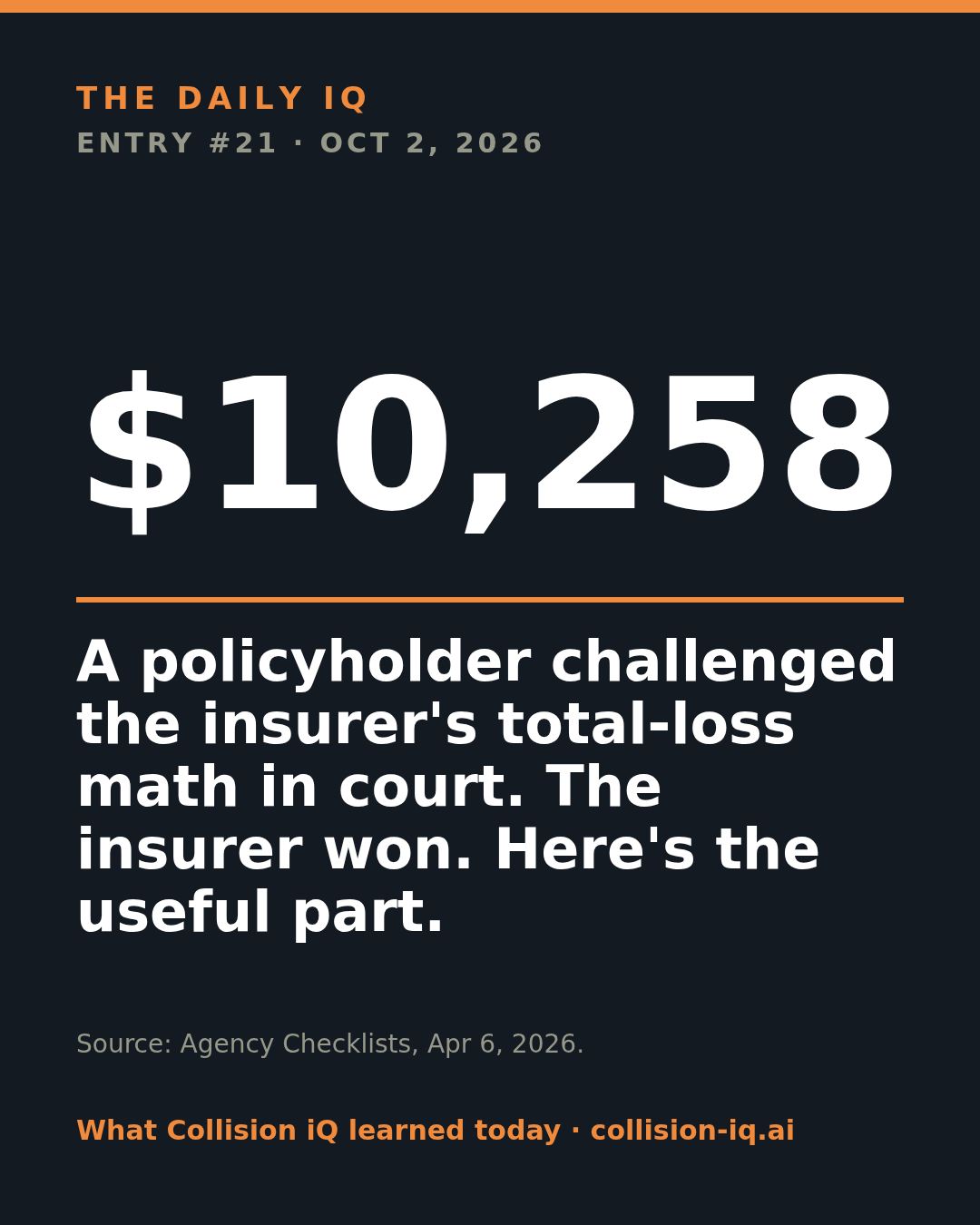
Entry #21Total loss & valuation

A policyholder challenged the insurer's total-loss math in court. The insurer won. Here's the useful part.

$10,258Commerce Insurance's total-loss valuation, upheld on summary judgment against a roughly $15,142 demand, Parsons v. Commerce Insurance

In Parsons v. Commerce Insurance (Massachusetts Superior Court, decided March 13, 2026), the insurer valued a totaled 2014 Ford Focus at $10,258 by blending a vendor market valuation report (75%) with a published guide value (25%). The owner wanted about $15,142 and challenged the valuation method itself. The court granted the insurer summary judgment: the method followed the valuation factors state regulation requires, and the owner offered no expert evidence the car was worth more. An appeal was filed March 26, 2026, per Agency Checklists' April 6, 2026 coverage.

The lesson isn't that the method can't be challenged. It's that attacking the methodology in the abstract lost here, while nothing in the ruling stops a policyholder from answering the valuation report with real, verifiable comparable vehicles and a documented counter-value. Courts respond to inventory, not indignation.

Why it matters

This is the losing argument to avoid and the winning one to use: don't argue the method is unfair in general — bring specific comparable listings that undercut the report's own comps.

How Collision iQ uses it

Filed into the knowledge base as the case-law reference behind Value iQ's guidance on contesting a total-loss valuation.

Sources — open in a new tab
#totalloss#actualcashvalue#insuranceclaim#caraccident#knowyourrights
The Daily iQ entry 21 card: Parsons v. Commerce Insurance, Massachusetts Superior Court, March 13 2026 — insurer's blended ACV method upheld on summary judgment.

Share card · opens in a new tab
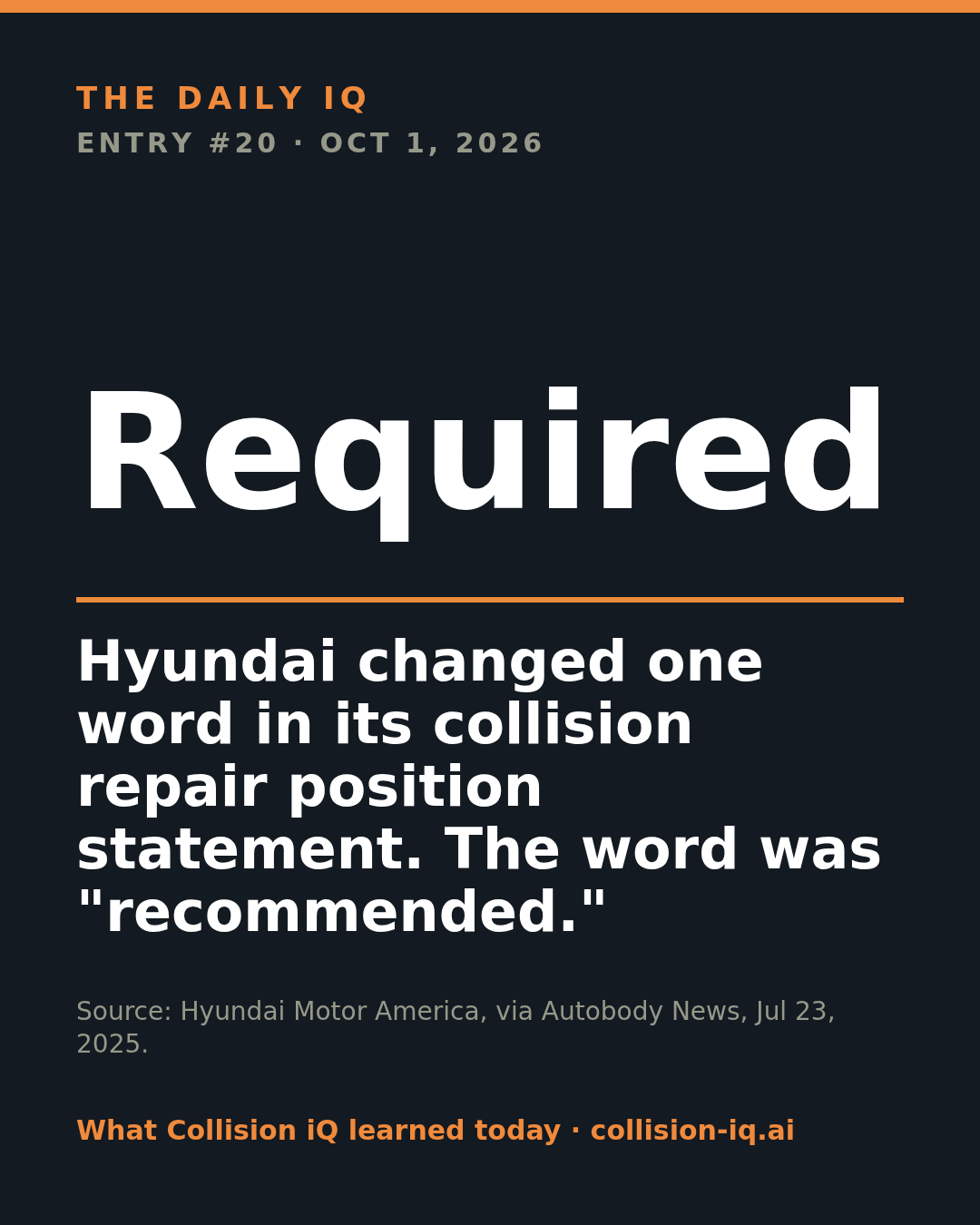
Entry #20OEM position statements

Hyundai changed one word in its collision repair position statement. The word was "recommended."

RequiredHyundai's position statement now requires, not recommends, pre- and post-repair scans

Hyundai's collision repair position statement now reads "required": a pre-repair scan to surface diagnostic trouble codes before work begins — even with no warning light on the dash — and a post-repair scan to verify every system works before the car goes back to its owner. A Hyundai senior manager of wholesale parts sales operations said the change in wording is about repair quality, per Autobody News' coverage.

A position statement is the manufacturer's written word on what a proper repair includes. When a scan line gets struck from an estimate, this is the document a shop points to. The carmaker has already had the argument.

Why it matters

Dating note: the Autobody News coverage of this update is dated July 23, 2025 — about 14 months old, not a 2026 story. The position statement itself is still Hyundai's current one; this is flagged for transparency about the source date, not because the substance is stale.

How Collision iQ uses it

Filed into the knowledge base as the OEM scan-requirement reference for Hyundai vehicles.

Sources — open in a new tab
#hyundai#adas#collisionrepair#diagnosticscan#insuranceclaim
The Daily iQ entry 20 card: Hyundai's position statement changed "recommended" to "required" for pre- and post-repair diagnostic scans.

Share card · opens in a new tab
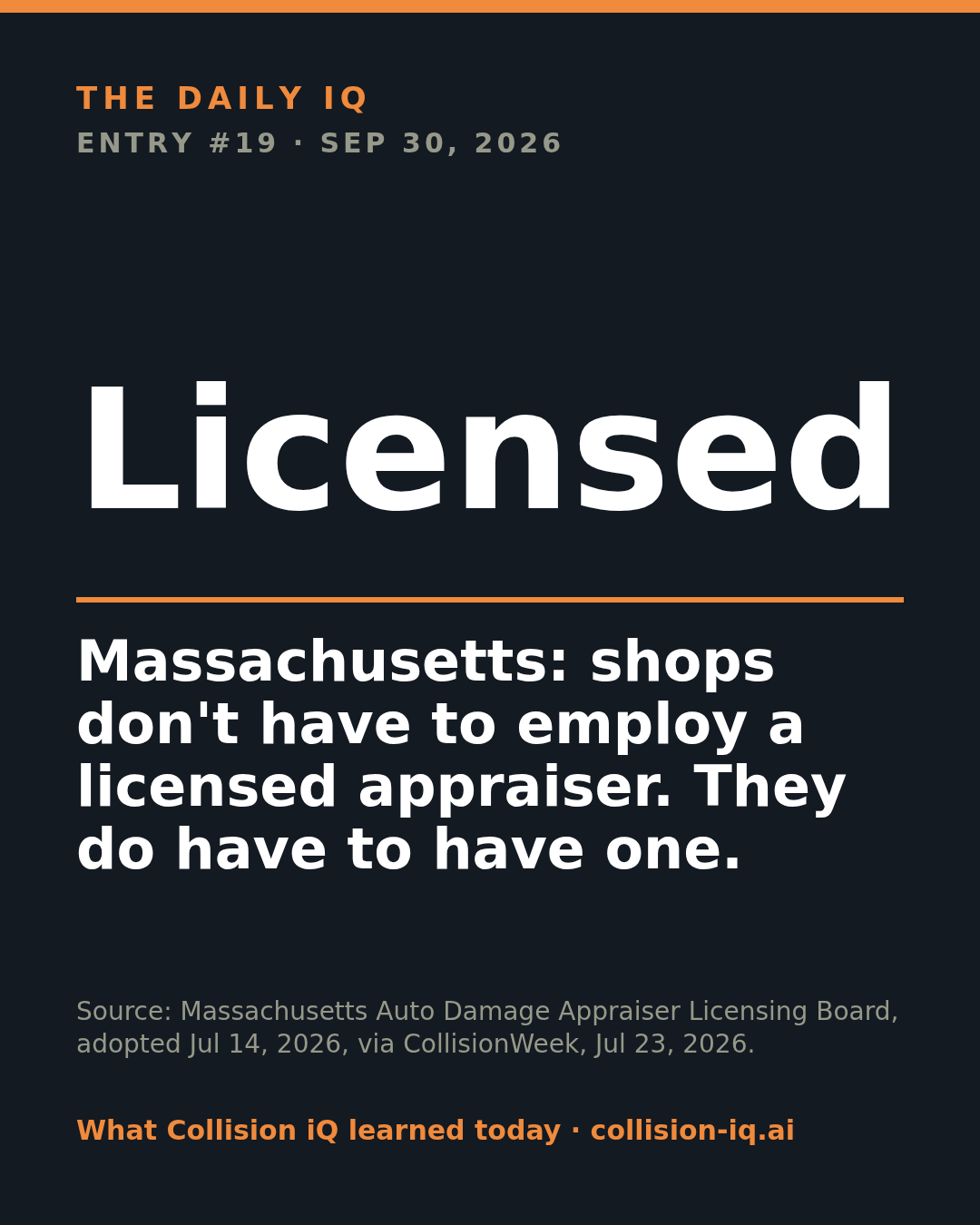
Entry #19Law & regulation

Massachusetts: shops don't have to employ a licensed appraiser. They do have to have one.

LicensedMassachusetts Advisory Ruling 2026-1: every shop appraisal needs a licensed appraiser, on staff or retained (adopted July 14, 2026)

On July 14, 2026, the Massachusetts Auto Damage Appraiser Licensing Board adopted Advisory Ruling 2026-1: a repair shop can satisfy the state's appraiser requirement by retaining or engaging a licensed appraiser as a subcontractor rather than hiring one on staff — and noncompliance can mean fines and penalties, per CollisionWeek's July 23, 2026 coverage.

The detail worth sitting with: in Massachusetts, the person who writes the damage appraisal must be licensed, full stop. Most states leave that role to whoever the insurer or shop assigns. Where appraising is a licensed profession, "who valued your loss, and what are their credentials" has a paper answer.

Why it matters

A licensing requirement gives an owner or shop a concrete document to ask for — a credential, not just a company's word — before accepting a valuation.

How Collision iQ uses it

Filed into the knowledge base as the Massachusetts-specific licensing reference behind the appraiser-credential questions Collision iQ surfaces.

Sources — open in a new tab
#massachusetts#autoappraisal#collisionrepair#insuranceclaim#bodyshop
The Daily iQ entry 19 card: Massachusetts Advisory Ruling 2026-1 requires a licensed appraiser, on staff or retained, behind every shop appraisal.

Share card · opens in a new tab
Entry #18Repair economics

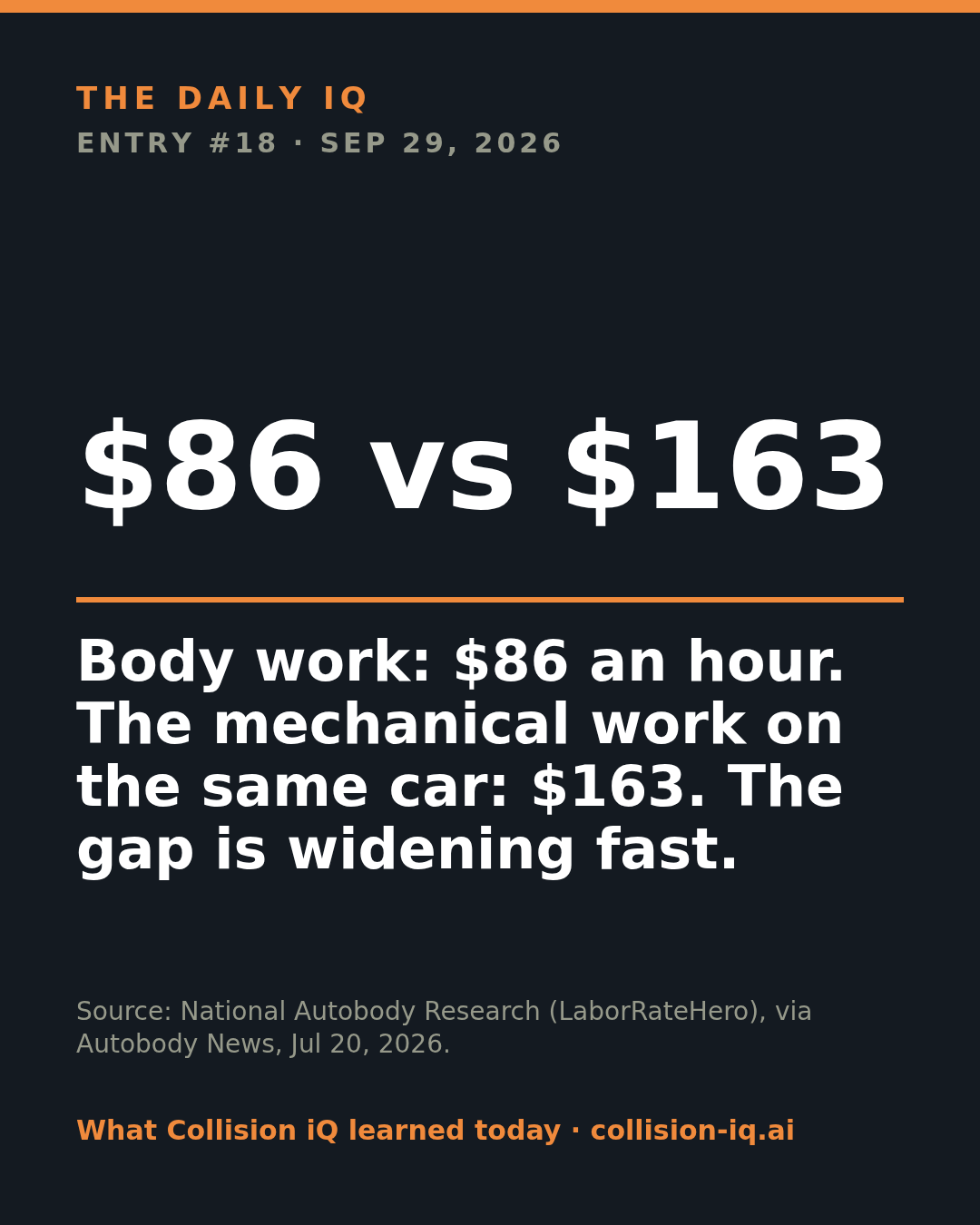
Body work: $86 an hour. The mechanical work on the same car: $163. The gap is widening fast.

$86 vs $163national average posted body vs. mechanical labor rate, June 2026, per National Autobody Research

National Autobody Research's LaborRateHero data for June 2026 puts the national average posted rate at $86/hour for body, $85 for refinish, and $163 for mechanical — mechanical rose 11.6% year over year, nearly double the pace of the other two, per Autobody News' July 20, 2026 coverage.

Modern collision repairs are increasingly mechanical: electronics, calibrations, battery handling, suspension. When an estimate prices that work at a body rate instead of a mechanical one, the file is quietly short by the difference on every hour billed.

Why it matters

A labor-rate mismatch is easy to miss because the estimate still shows a rate — just the wrong one for the work being described. The dollar gap compounds across every mechanical hour on the file.

How Collision iQ uses it

Filed into the knowledge base as the reference rate spread Collision iQ checks estimate labor-rate coding against.

Sources — open in a new tab
#laborrates#collisionrepair#autobody#insuranceestimate#mechanic
The Daily iQ entry 18 card: body labor averaging $86/hour versus $163/hour for mechanical, June 2026.

Share card · opens in a new tab
Entry #17Insurance industry data

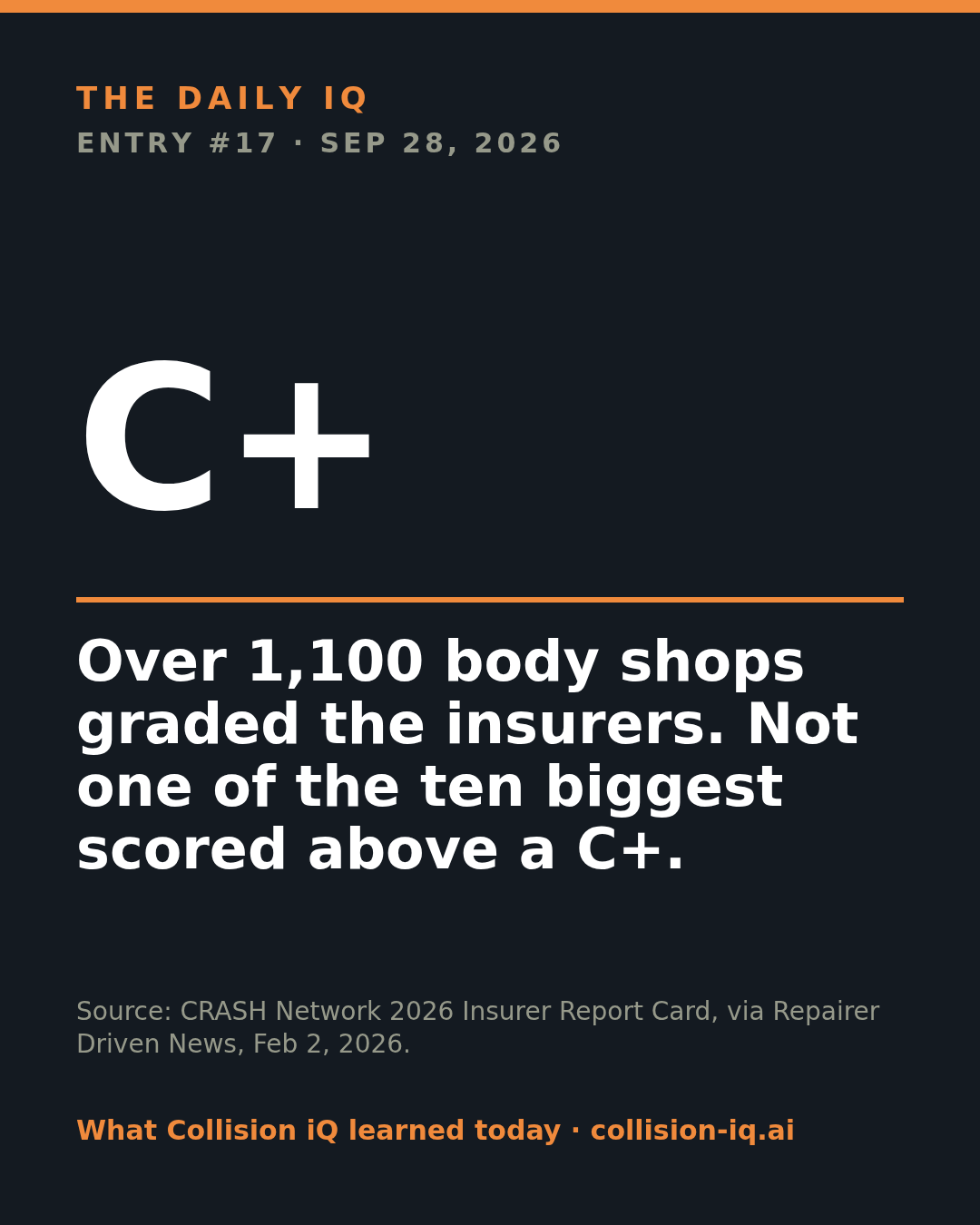
Over 1,100 body shops graded the insurers. Not one of the ten biggest scored above a C+.

C+best grade earned by any of the ten largest national auto insurers, per CRASH Network's 2026 Insurer Report Card

CRASH Network's 2026 Insurer Report Card asked more than 1,100 U.S. body shops to grade up to 40 carriers on whether their policies, attitude, and payment practices support quality repairs. Seven insurers earned an A- or higher, led by regional and specialty carriers. The ten largest national insurers — the ones writing most of the country's claims — topped out at C+, and 22 companies landed at C- or lower, per Repairer Driven News' February 2, 2026 coverage of the report.

Shops grade the carrier they invoice, not the one in the commercial. The gap between market share and shop-floor grade is worth knowing before assuming the biggest name handles claims best.

Why it matters

A grade from the people processing thousands of claims a year is a different signal than brand awareness — it measures how a carrier actually behaves once a claim is open, not how it markets itself beforehand.

How Collision iQ uses it

Filed into the knowledge base as the field-reputation reference for the report-card series — context for claim behavior that a policy document alone won't show.

Sources — open in a new tab
#carinsurance#insuranceclaim#bodyshop#collisionrepair#autoinsurance
The Daily iQ entry 17 card: none of the ten largest national auto insurers scored above a C+ in the 2026 Insurer Report Card.

Share card · opens in a new tab
Entry #16Total loss & valuation

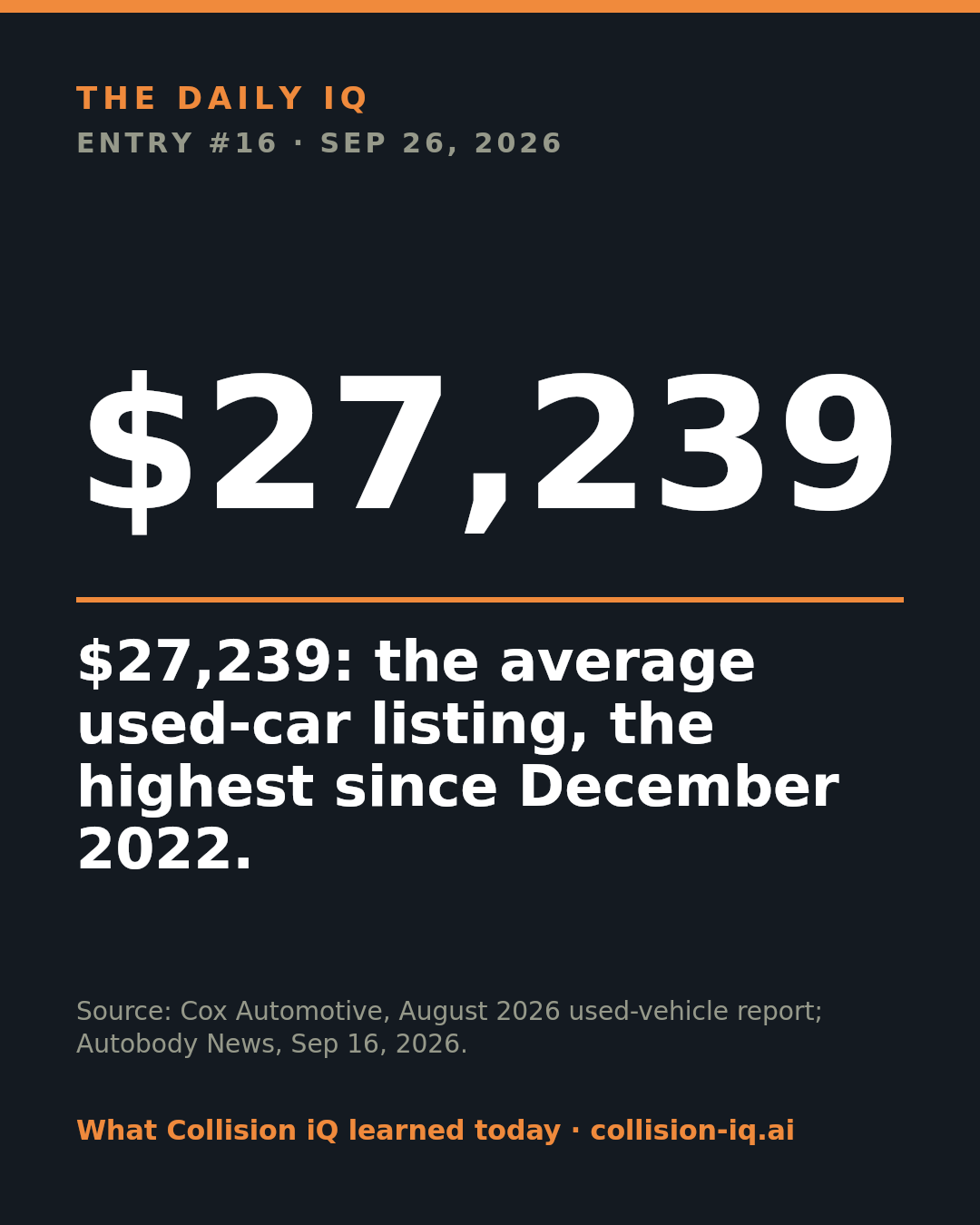
$27,239: the average used-car listing, the highest since December 2022.

$27,239average U.S. used-vehicle listing price in August 2026, up 7% in a year, per Cox Automotive

In August 2026 the average U.S. used-vehicle listing price reached $27,239, up 7% from a year earlier and the highest monthly average since December 2022, per Cox Automotive. Supply under $15,000 fell 25.9% year over year to 15.1% of used inventory, down from 20.6%. Autobody News' review of six months of used-vehicle data, published September 16, 2026, sets those swings against a record 23.1% total-loss rate.

Why the retail number matters if your car gets totaled: you replace your car at retail. A valuation built on soft comparables drifts away from the market you actually have to buy in, and the ordinary, older car is the one most exposed.

Why it matters

A total-loss check is only fair if it buys the same car back in the same market. When listings hit a four-year high, a valuation that has not moved with them is a valuation worth auditing.

How Collision iQ uses it

Filed into the knowledge base as the dated retail-market reference Value iQ reads against a total-loss valuation's comparables.

Sources — open in a new tab
#usedcars#totalloss#actualcashvalue#carinsurance#carmarket
The Daily iQ entry 16 card: average used-vehicle listing price of $27,239 in August 2026, highest since December 2022.

Share card · opens in a new tab
Entry #15Law & regulation

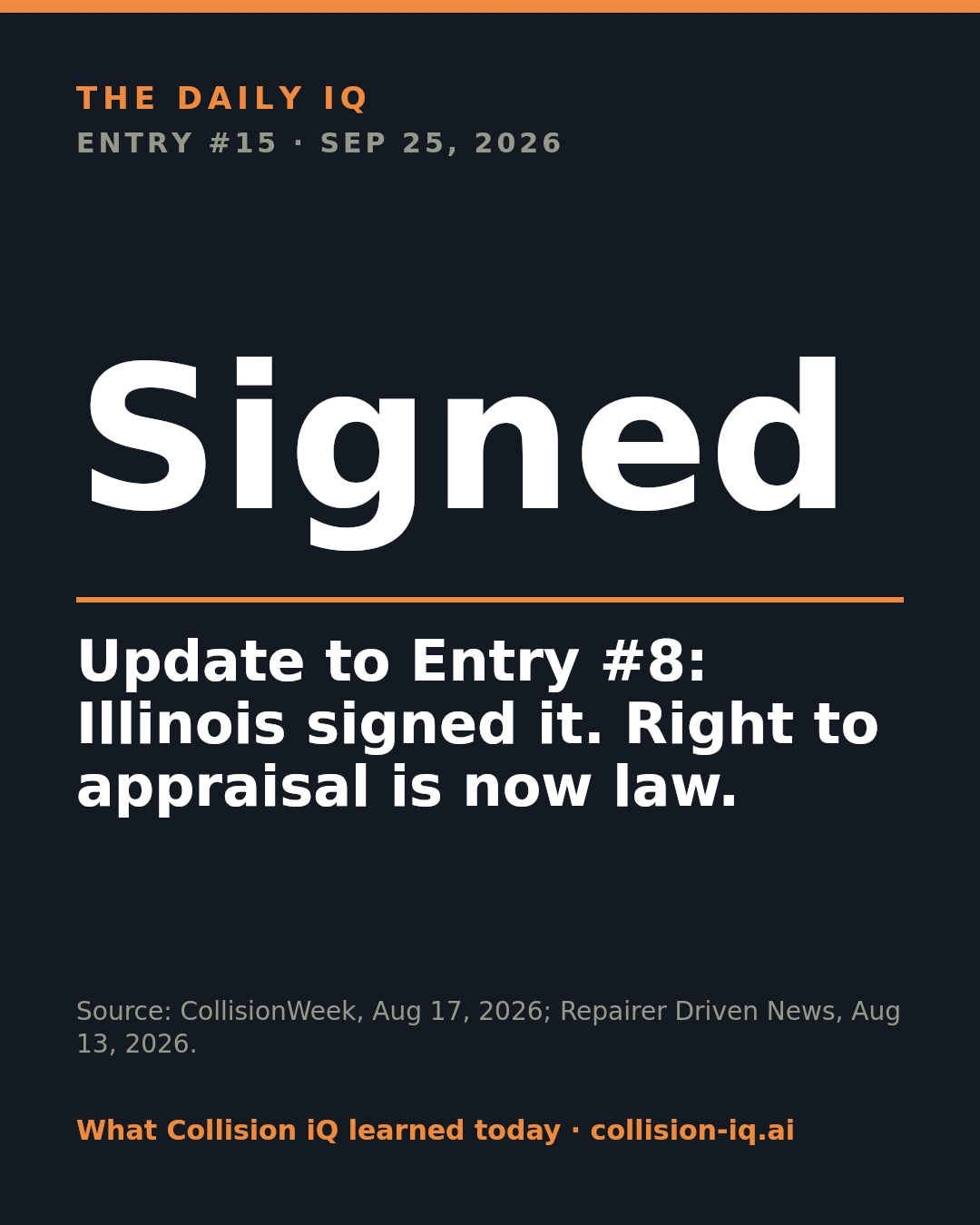
Update to Entry #8: Illinois signed it. Right to appraisal is now law.

SignedHB 4160 became Public Act 104-0767 on August 7, 2026; mandatory appraisal provisions from July 1, 2027

When this knowledge base filed Entry #8, HB 4160 was a bill moving through the Illinois legislature. On August 7, 2026, Governor Pritzker signed it. Now Public Act 104-0767, it adds a new Section 398 to the Illinois Insurance Code: starting July 1, 2027, policies carrying first-party auto physical damage coverage must include an appraisal provision that either the insured, at the insured's sole discretion, or the insurer can invoke when the amount of a loss is disputed.

That is two states this year, Illinois writing the clause into every policy and Texas printing the right on every renewal, moving the appraisal clause from fine print toward common knowledge. It is also what a knowledge base is for: the entries keep growing after they are filed.

Why it matters

A bill can stall; a signed act has a date. From July 1, 2027, an Illinois policyholder who disputes a valuation has a binding path to a number without a courtroom.

How Collision iQ uses it

Filed into the knowledge base as the successor to Entry #8, so the Illinois appraisal reference Collision iQ cites reads the enacted statute, not the bill.

Sources — open in a new tab
#righttoappraisal#illinois#autoinsurance#insuranceclaim#knowyourrights
The Daily iQ entry 15 card: Illinois HB 4160 signed into law as Public Act 104-0767, effective July 1, 2027.

Share card · opens in a new tab
Entry #14Insurance industry data

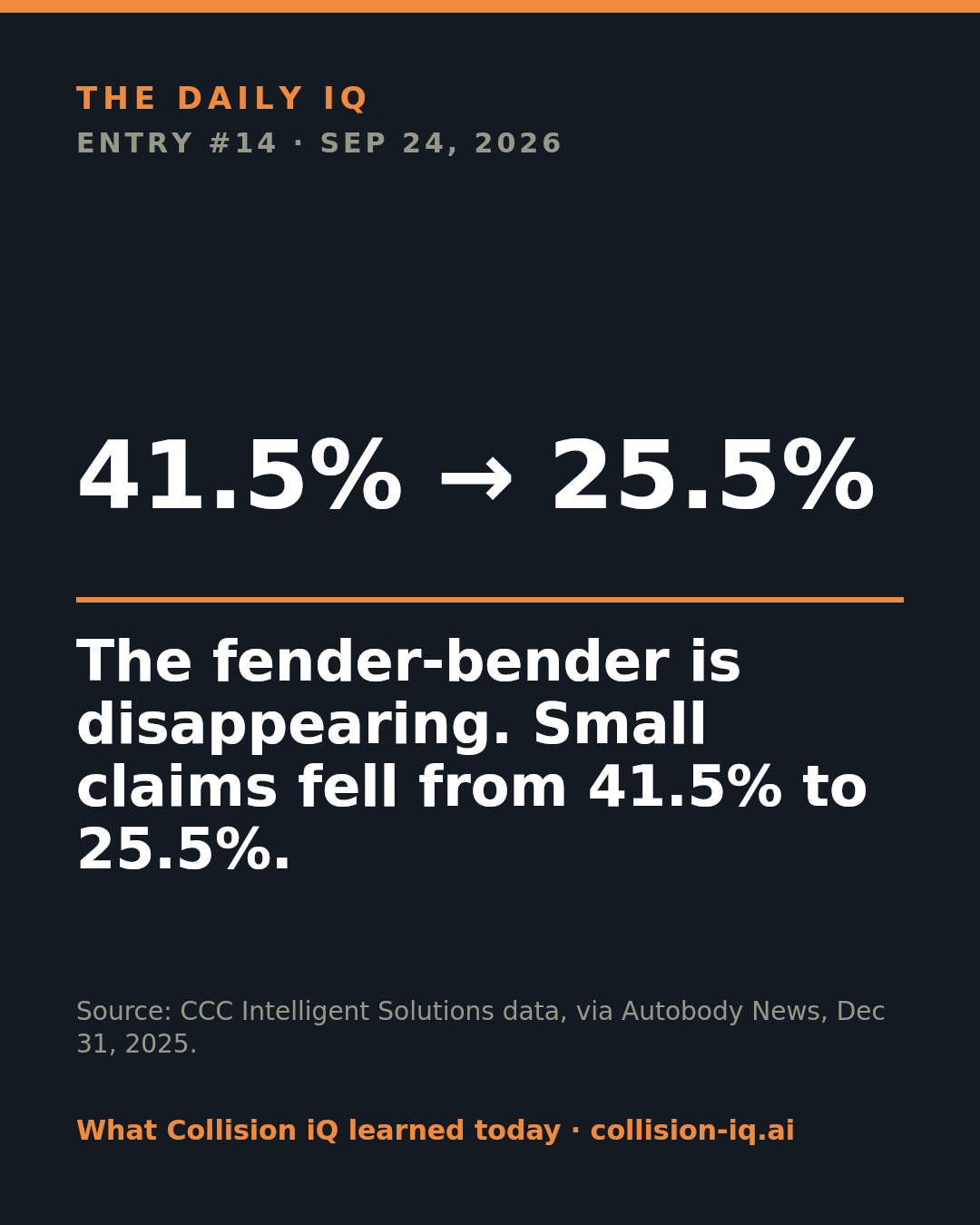
The fender-bender is disappearing. Small claims fell from 41.5% to 25.5%.

41.5% → 25.5%share of repairable appraisals for damage of $2,000 or less, 2019 to mid-2025, per CCC

In 2019, 41.5% of repairable appraisals were for damage of $2,000 or less. By mid-2025 that share had fallen to 25.5%, and repairable claims overall dropped 10.4% year over year through August 2025, per CCC Intelligent Solutions data reported by Autobody News on December 31, 2025. The same report notes 26% of auto insurance customers now carry deductibles of $1,000 or more.

Two things are happening at once: bumpers full of sensors turned small hits into big estimates, and owners with high deductibles stopped filing for the hits that stayed small. What is left in the system is the expensive, complicated claim, exactly the kind where a missing line costs the most.

Why it matters

If nearly every claim that gets filed is now a large one, every claim is worth reading line by line. The cheap claim that did not need scrutiny is the one that is going extinct.

How Collision iQ uses it

Filed into the knowledge base as the claims-mix context for why estimate review matters on the claims that still get filed.

Sources — open in a new tab
#carinsurance#insuranceclaim#collisionrepair#autoclaims#deductible
The Daily iQ entry 14 card: repairable appraisals of $2,000 or less fell from 41.5% in 2019 to 25.5% in mid-2025.

Share card · opens in a new tab
Entry #13Repair economics

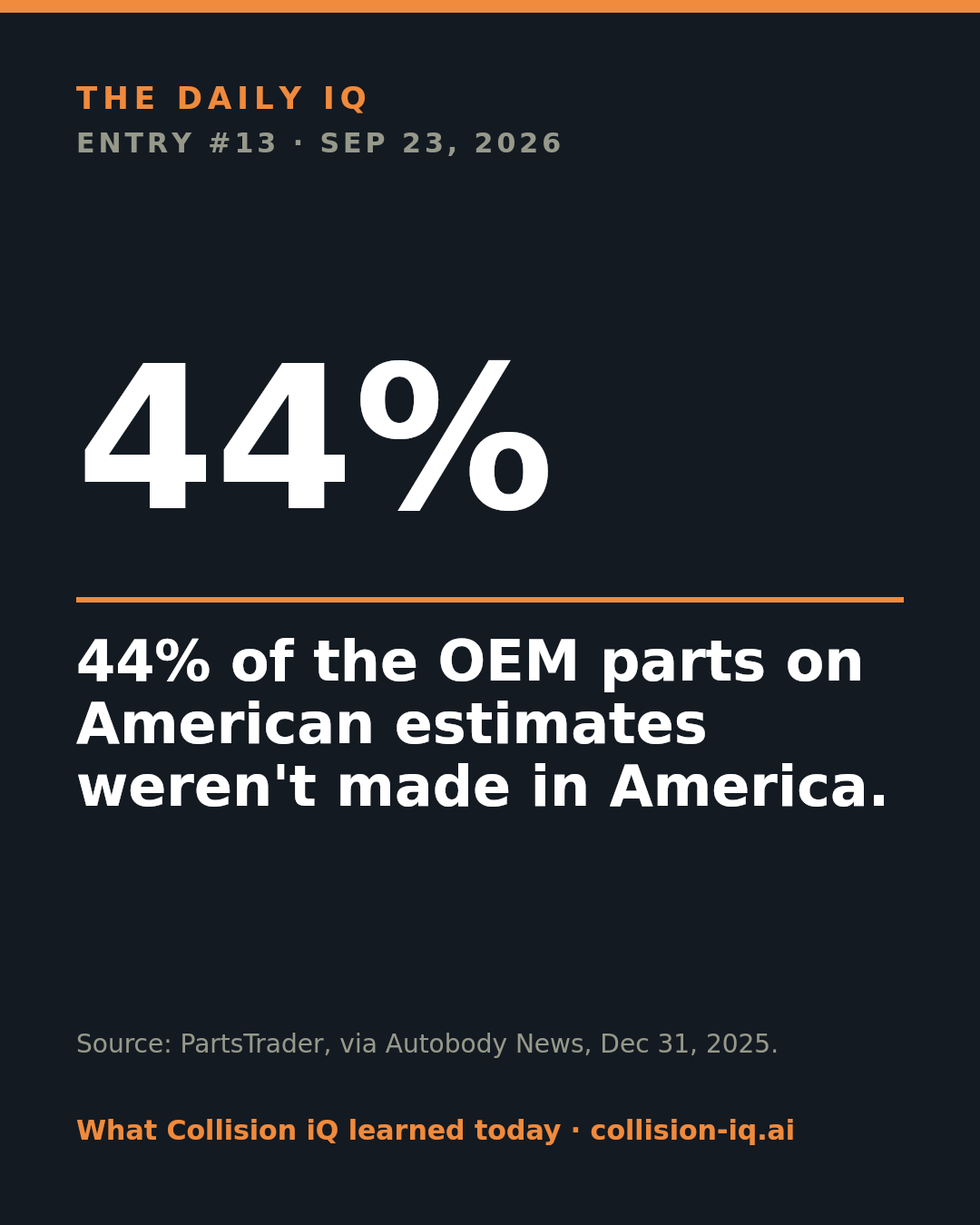
44% of the OEM parts on American estimates weren't made in America.

44%of OEM collision parts sold in the U.S. are manufactured overseas, per PartsTrader; tariffs add about $100 to an average repair order

Per parts-procurement platform PartsTrader, 44% of OEM collision parts sold in the U.S. are manufactured overseas, and 2025's tariffs added roughly $100 to the parts line of an average repair order, passed through supplier pricing, as reported by Autobody News on December 31, 2025.

A hundred dollars does not sound like much until you remember how estimates die: not in one big cut, but a hundred dollars at a time. When parts prices move and the estimate does not, the difference has to come from somewhere, usually the lines that are easiest not to write.

Why it matters

Parts prices are not static between the first estimate and the supplement. A parts line written months ago may no longer buy the part it names.

How Collision iQ uses it

Filed into the knowledge base as the dated context for reading parts pricing on an estimate against current supplier pricing.

#oemparts#collisionrepair#autoparts#carinsurance#autoindustry
The Daily iQ entry 13 card: 44% of OEM collision parts sold in the U.S. are made overseas.

Share card · opens in a new tab
Entry #12ADAS & calibration

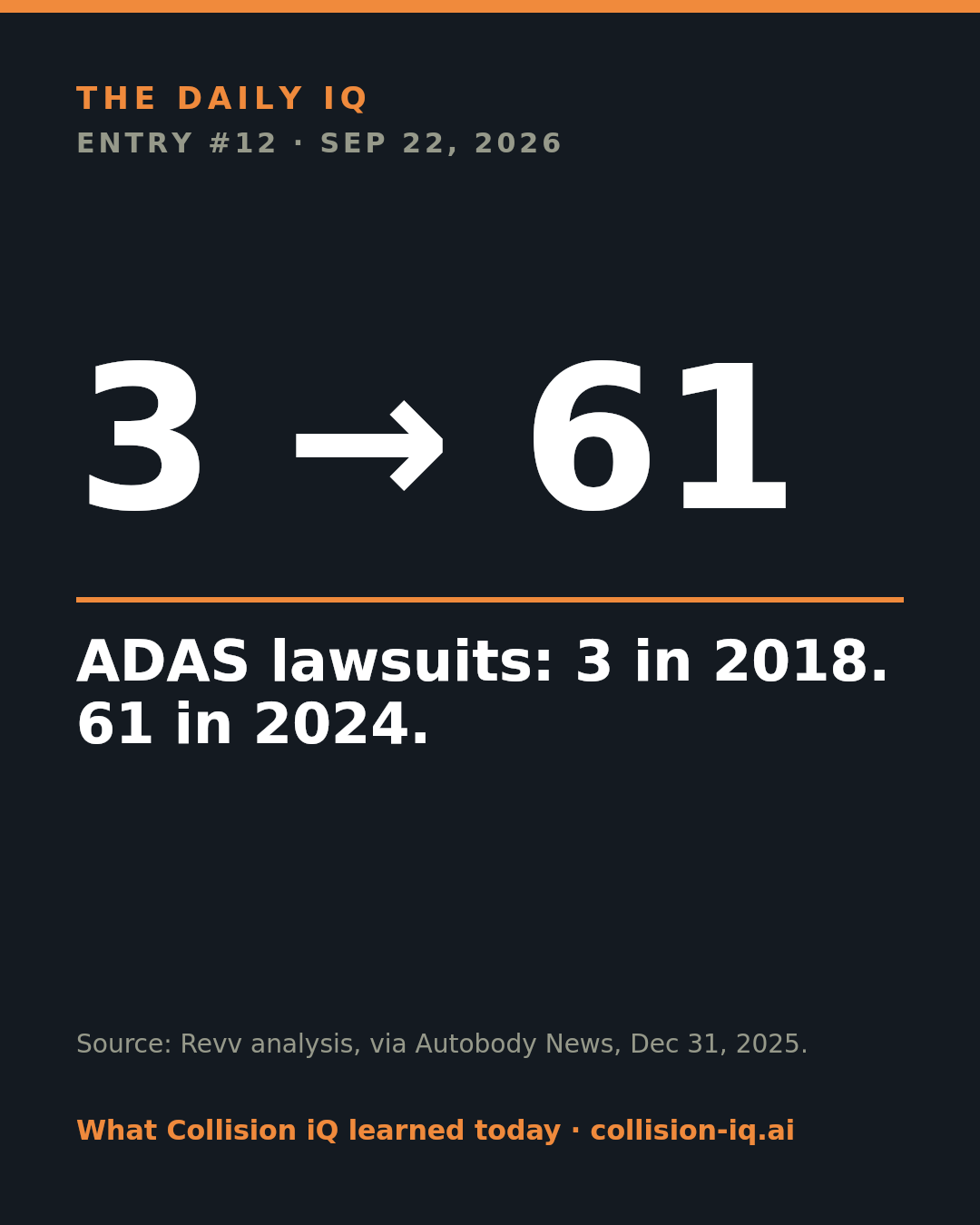
ADAS lawsuits: 3 in 2018. 61 in 2024.

3 → 61lawsuits tied to advanced driver-assistance systems, 2018 to 2024, per a Revv analysis

Lawsuits tied to advanced driver-assistance systems, the cameras and radars that brake and steer for you, grew from 3 cases in 2018 to 61 in 2024, with typical settlements and judgments running $200,000 to more than $1 million, according to an analysis by calibration platform Revv reported by Autobody News on December 31, 2025.

When a required calibration is skipped after a repair, the miss does not show up at delivery. It shows up later, at speed, and then in a filing. That is why the calibration line on an estimate is a safety line, not padding.

Why it matters

A calibration that is not on the estimate is a calibration that was probably not done. The cost of the line is small; the cost of the miss is now measured in six and seven figures.

How Collision iQ uses it

Filed into the knowledge base as the liability context behind every missing-calibration flag Collision iQ raises.

Sources — open in a new tab
#adascalibration#carsafety#collisionrepair#insuranceclaim#adas
The Daily iQ entry 12 card: ADAS lawsuits grew from 3 in 2018 to 61 in 2024.

Share card · opens in a new tab
Entry #11Law & regulation

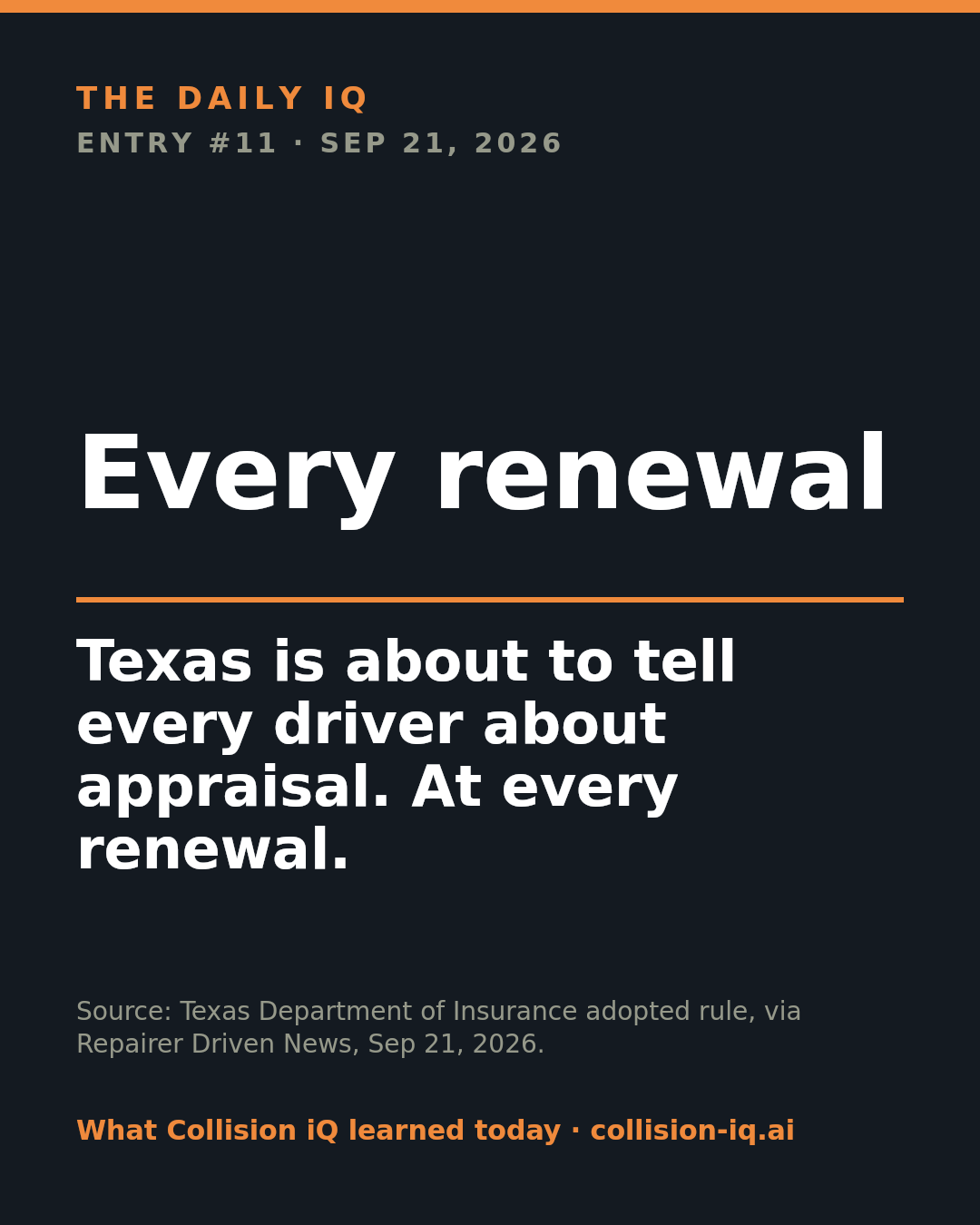
Texas is about to tell every driver about appraisal. At every renewal.

Every renewalTexas auto insurers must disclose the right to appraisal at issuance and renewal from January 1, 2027

The Texas Department of Insurance has adopted amendments to the state's Auto Bill of Rights that add a notice of “the right to request appraisal to resolve disputes about loss amounts.” Every Texas auto insurer must give it at policy issuance and at every renewal, starting January 1, 2027, two months later than the November 1, 2026 date TDI proposed on May 1, 2026.

The rule implements Senate Bill 458, which wrote a mandatory appraisal right into Insurance Code Chapter 1813 and took effect September 1, 2025. For years the appraisal clause worked mostly for the people who already knew it existed. A notice at every renewal changes who that is.

Why it matters

The appraisal clause is only useful to a policyholder who knows it is there. Printing it on every renewal turns a fine-print right into common knowledge.

How Collision iQ uses it

Filed into the knowledge base with the Texas appraisal references Collision iQ cites, updated from the proposed rule to the adopted one.

#righttoappraisal#texasinsurance#autoinsurance#insuranceclaim#knowyourrights
The Daily iQ entry 11 card: Texas auto insurers must disclose the right to appraisal at every renewal from January 1, 2027.

Share card · opens in a new tab
Entry #10OEM position statements

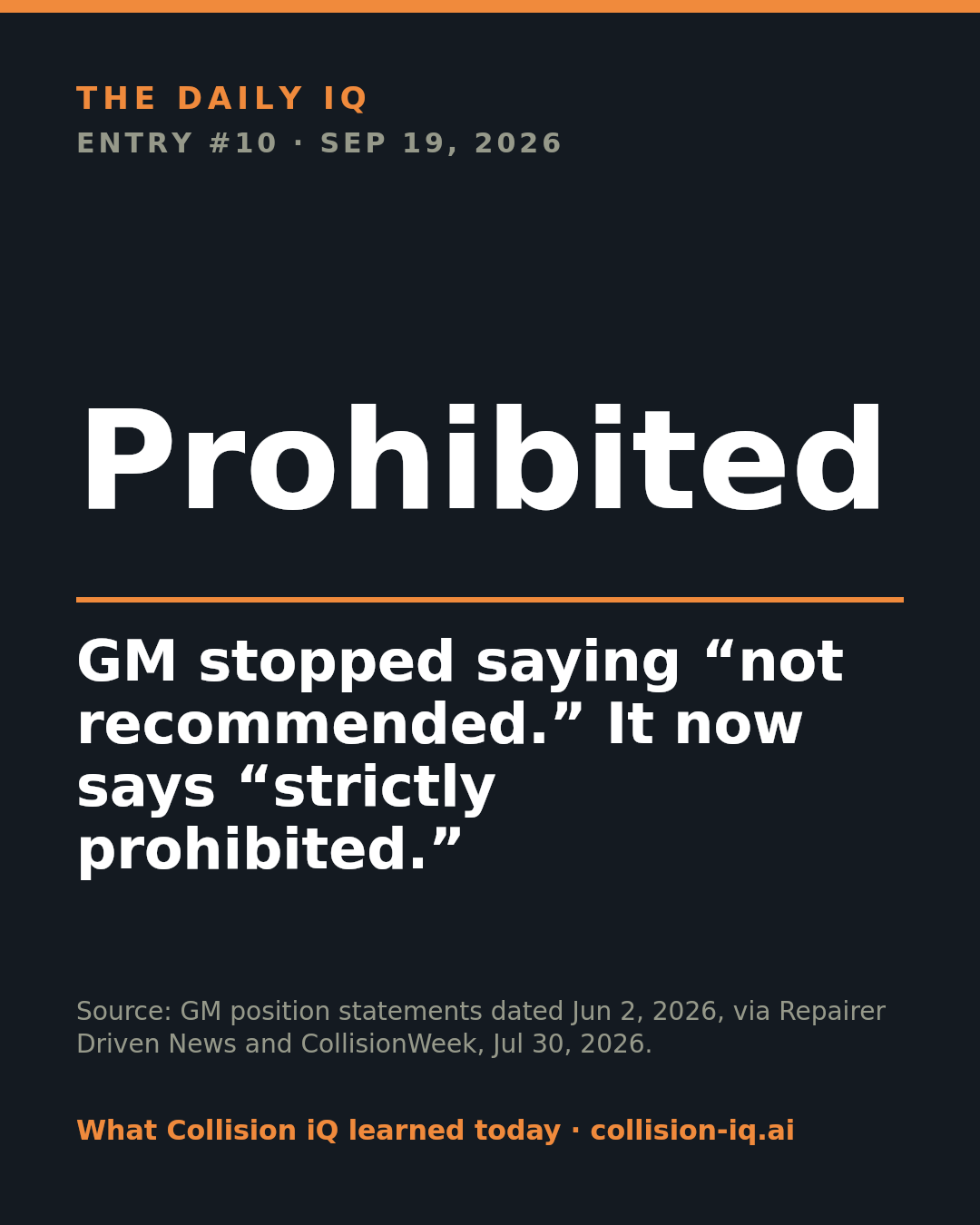
GM stopped saying “not recommended.” It now says “strictly prohibited.”

ProhibitedGM's word for salvage, reconditioned, remanufactured and aftermarket ADAS sensors, and aftermarket fascias on ADAS-equipped vehicles

GM rewrote its collision position statements, reported July 30, 2026. The ADAS statement, dated June 2, 2026, limits repairs to new GM Genuine radars, cameras, sensors, modules and related components and calls salvaged, recycled, reconditioned, remanufactured, aftermarket and other secondary-market ADAS parts “not approved and strictly prohibited.” A March version had said “not recommended”; an April 23 revision said “not approved.” A companion statement strictly prohibits aftermarket, reconditioned or salvage bumper fascias on ADAS-equipped GM vehicles.

A position statement is not a law. It is the manufacturer's written answer to “what does this repair require,” and it is what a line-by-line dispute gets measured against.

Why it matters

One word changed, and every estimate on a GM vehicle with a radar behind the bumper feels it. A part choice that used to be “discouraged” is now in writing as prohibited by the company that built the car.

How Collision iQ uses it

Filed into the knowledge base as an OEM position statement, cited by date, so a used or aftermarket sensor line on a GM estimate is checked against the manufacturer's own wording.

#gm#collisionrepair#adas#oemparts#insuranceclaim
The Daily iQ entry 10 card: GM position statements now say strictly prohibited for salvage and aftermarket ADAS sensors.

Share card · opens in a new tab
Entry #9Repair economics

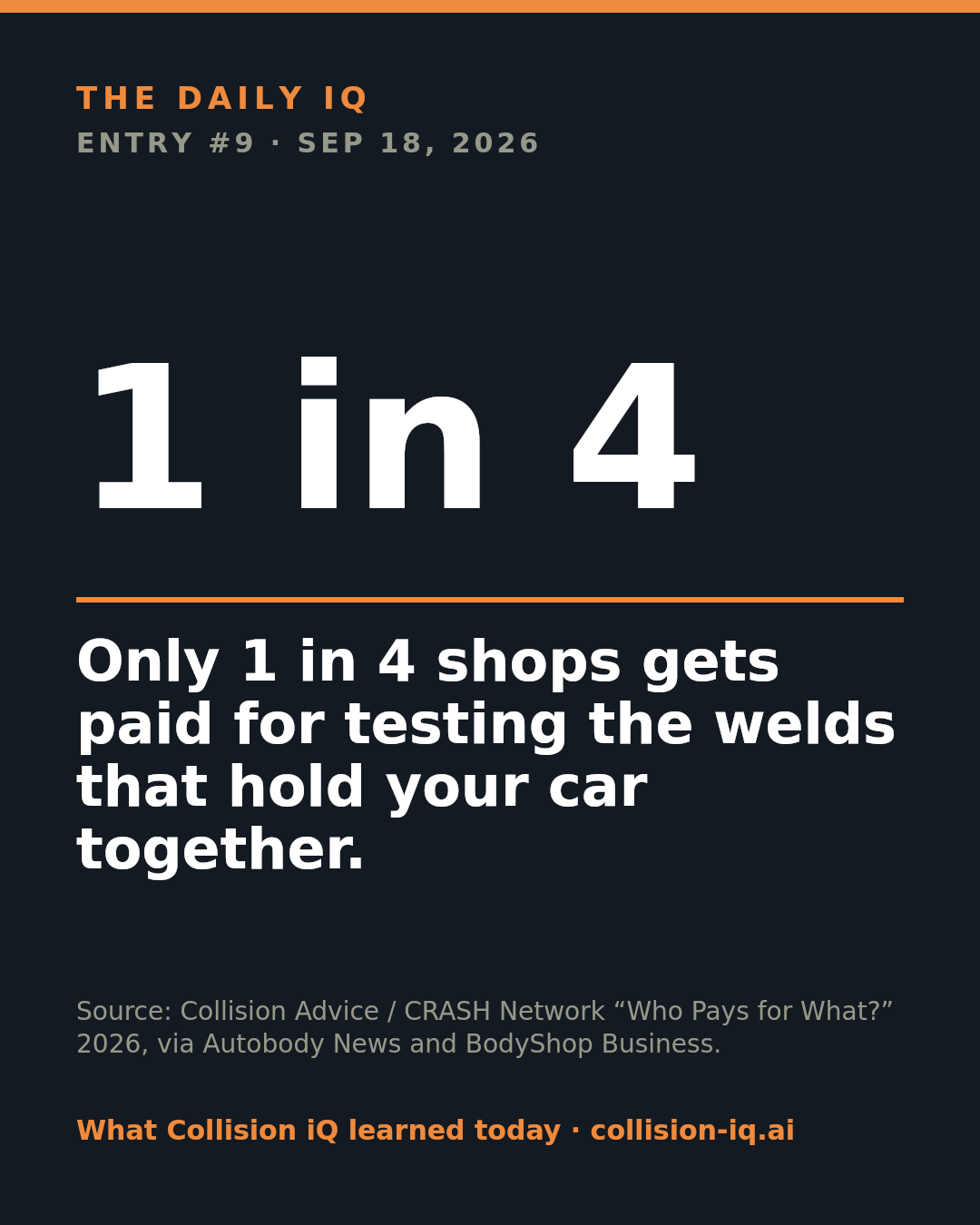
Only 1 in 4 shops gets paid for testing the welds that hold your car together.

1 in 4shops that negotiate for destructive weld testing are paid always or most of the time, down from 37% two years ago

Before welding structural parts on your car, a technician is supposed to weld test coupons of the same steel and tear them apart to prove the settings hold. In the 2026 “Who Pays for What?” Frame & Mechanical survey by Collision Advice and CRASH Network, run through April 2026 with 473 shops in 49 states responding, only 25% of shops that negotiate for that step are paid always or most of the time, down from 37% two years ago. The share saying insurers never pay for it rose from 32% to 44%.

A required test, performed on your car's structure, that usually goes unpaid. That is the state of “not included.”

Why it matters

A weld test is not an upsell; it is how a shop proves the welds on your structure will hold. When it goes unpaid, the pressure is to skip it, and a skipped test does not show up at delivery.

How Collision iQ uses it

Filed into the knowledge base as the dated reimbursement benchmark for destructive weld testing, so a missing test line is flagged as a required step, not an extra.

#collisionrepair#welding#autobody#carsafety#insuranceclaim
The Daily iQ entry 9 card: only 1 in 4 shops is paid for destructive weld testing.

Share card · opens in a new tab

Entry #8Law & regulation

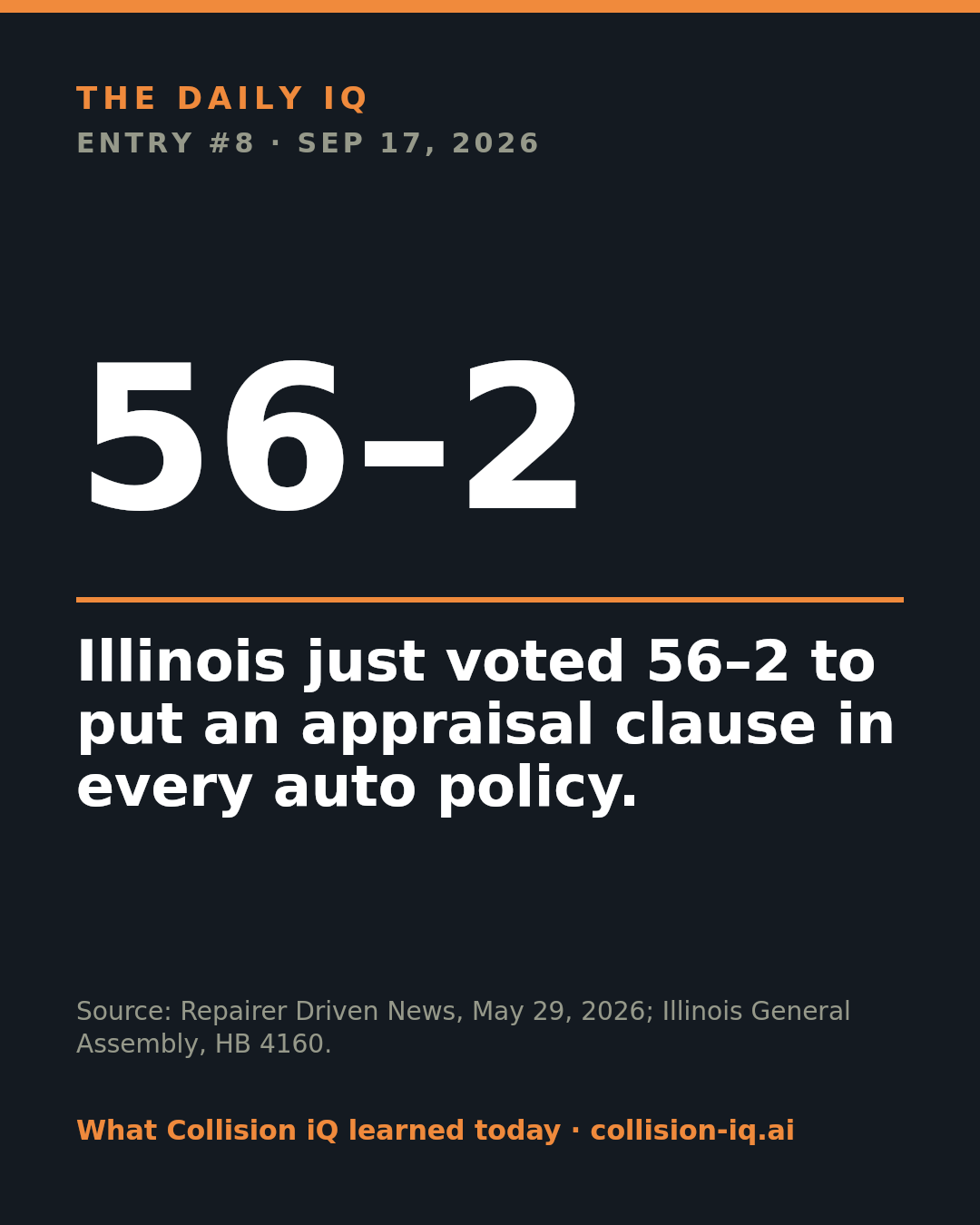
Illinois just voted 56–2 to put an appraisal clause in every auto policy.

56–2Illinois Senate vote on HB 4160, the right-to-appraisal bill, May 28, 2026

HB 4160 passed the Illinois Senate 56–2 on May 28, 2026, and the House concurred 115–0 on May 31. As passed, every auto policy with first-party physical damage coverage issued or renewed from July 1, 2027 must let either the insured, without the insurer's consent, or the insurer invoke appraisal when the amount of a loss is disputed. Each side pays its own appraiser; the umpire's cost is split.

Why it matters beyond Illinois: the clause that already resolves disputes quietly in most policies is being written into statute, with a process attached. Legislators noticed what it does.

Why it matters

Appraisal is the one dispute mechanism that ends in a binding number without a lawsuit. When a legislature makes it mandatory, it is confirming that the mechanism works.

How Collision iQ uses it

Filed into the knowledge base alongside the appraisal-clause references Collision iQ cites when a valuation or repair-cost dispute stalls.

Sources — open in a new tab
#appraisalclause#insuranceclaim#knowyourrights#autoinsurance#illinois
The Daily iQ entry 8 card: Illinois Senate votes 56 to 2 for HB 4160, mandatory appraisal clause in auto policies.

Share card · opens in a new tab

Entry #7Repair economics

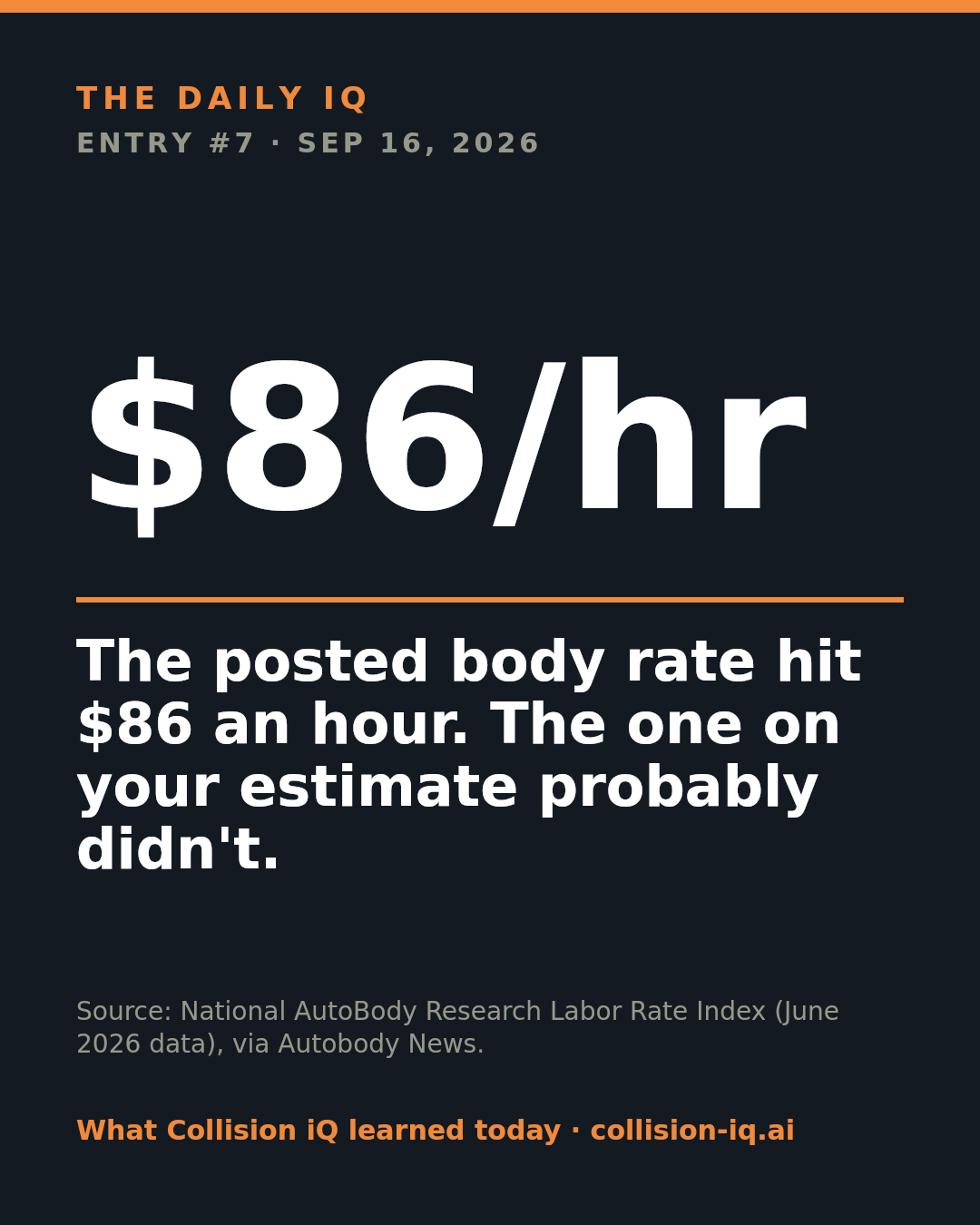
The posted body rate hit $86 an hour. The one on your estimate probably didn't.

$86/hrnational average posted body labor rate, June 2026, up 6.2% in a year; mechanical reached $163/hr

National average posted labor rates for June 2026, per National AutoBody Research's Labor Rate Index: body $86 an hour, up 6.2% in a year, and mechanical $163 an hour, up 11.6% from $146, climbing nearly twice as fast as body work. The figures come from NABR's LaborRateHero platform, reported by Autobody News.

“Posted” is what shops charge. What an insurer's estimate pays is often a different number, and the space between those two rates, multiplied by every labor hour on the file, is where many repair disputes actually live.

Why it matters

A labor rate is one number that touches every line of an estimate. When the posted rate and the paid rate differ, the difference is not a rounding error; it compounds across the whole repair.

How Collision iQ uses it

Filed into the knowledge base as the dated national posted-rate reference for reading the rate line on an estimate.

Sources — open in a new tab
#laborrates#collisionrepair#autobody#bodyshop#insuranceclaim
The Daily iQ entry 7 card: national average posted body labor rate of $86 an hour in June 2026.

Share card · opens in a new tab

Entry #6Repair economics

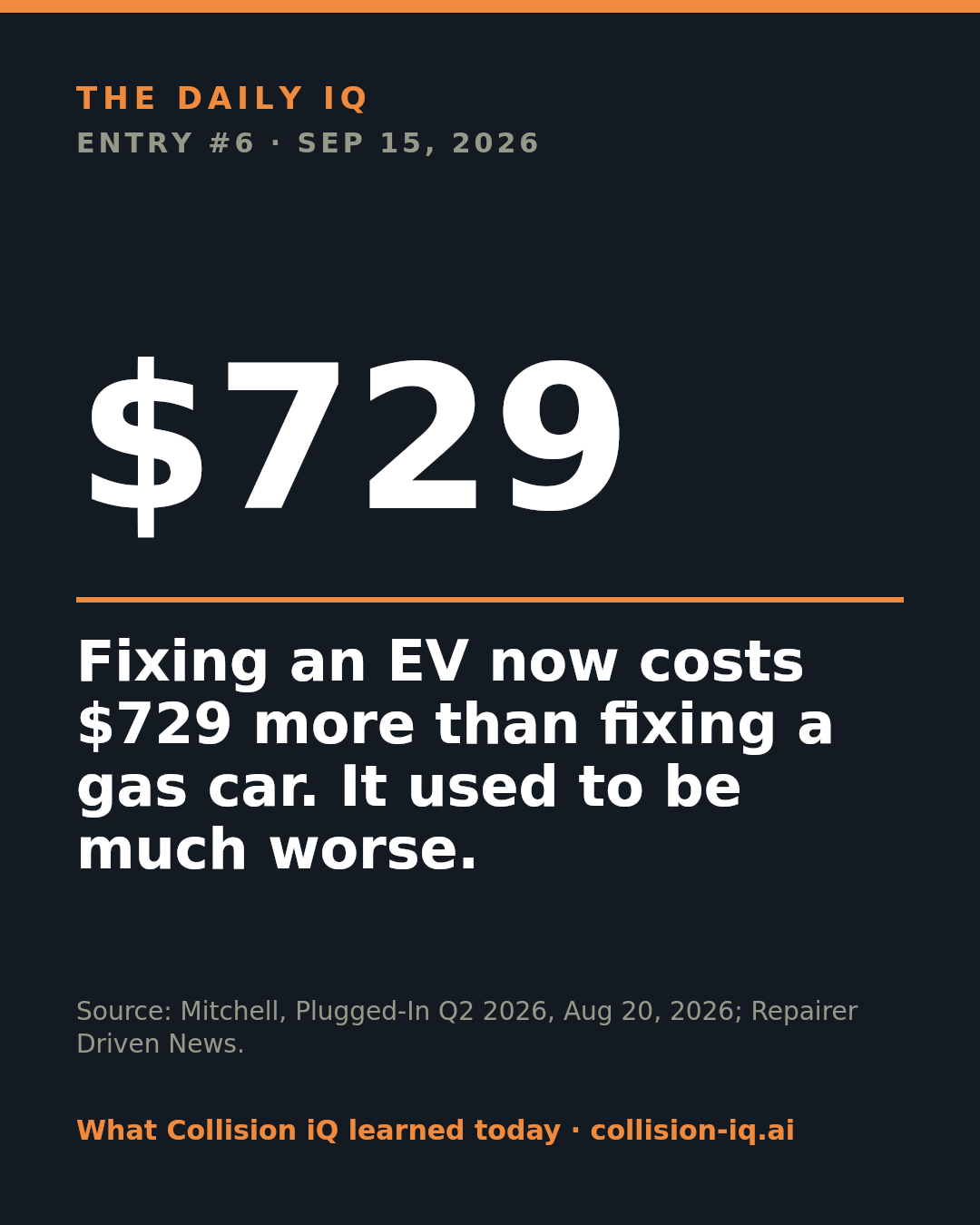
Fixing an EV now costs $729 more than fixing a gas car. It used to be much worse.

$729gap between average repairable claim severity for battery-electric and gas vehicles, a record low

Average repairable claim severity last quarter in the U.S.: $5,684 for battery-electric vehicles against $4,955 for gas vehicles, per Mitchell's “Plugged-In: EV Collision Insights” Q2 2026 report, published August 20, 2026. The gap, once the industry's favorite scare number, is the smallest on record.

Two reasons it is closing: the EV fleet is aging into ordinary repairs, and the worst-hit EVs increasingly total out instead of pulling the repair average up.

Why it matters

The “EVs cost a fortune to fix” argument is used on both sides of a claim. The current number is $729, and it is shrinking. Any estimate or valuation that leans on the old gap is leaning on last year's data.

How Collision iQ uses it

Filed into the knowledge base as the current benchmark for EV versus gas repair severity, dated so it can be superseded next quarter.

Sources — open in a new tab
#evrepair#electricvehicles#collisionrepair#autoclaims#teslarepair
The Daily iQ entry 6 card: $729 gap between EV and gas repairable claim severity, a record low.

Share card · opens in a new tab

Entry #5Insurance industry data

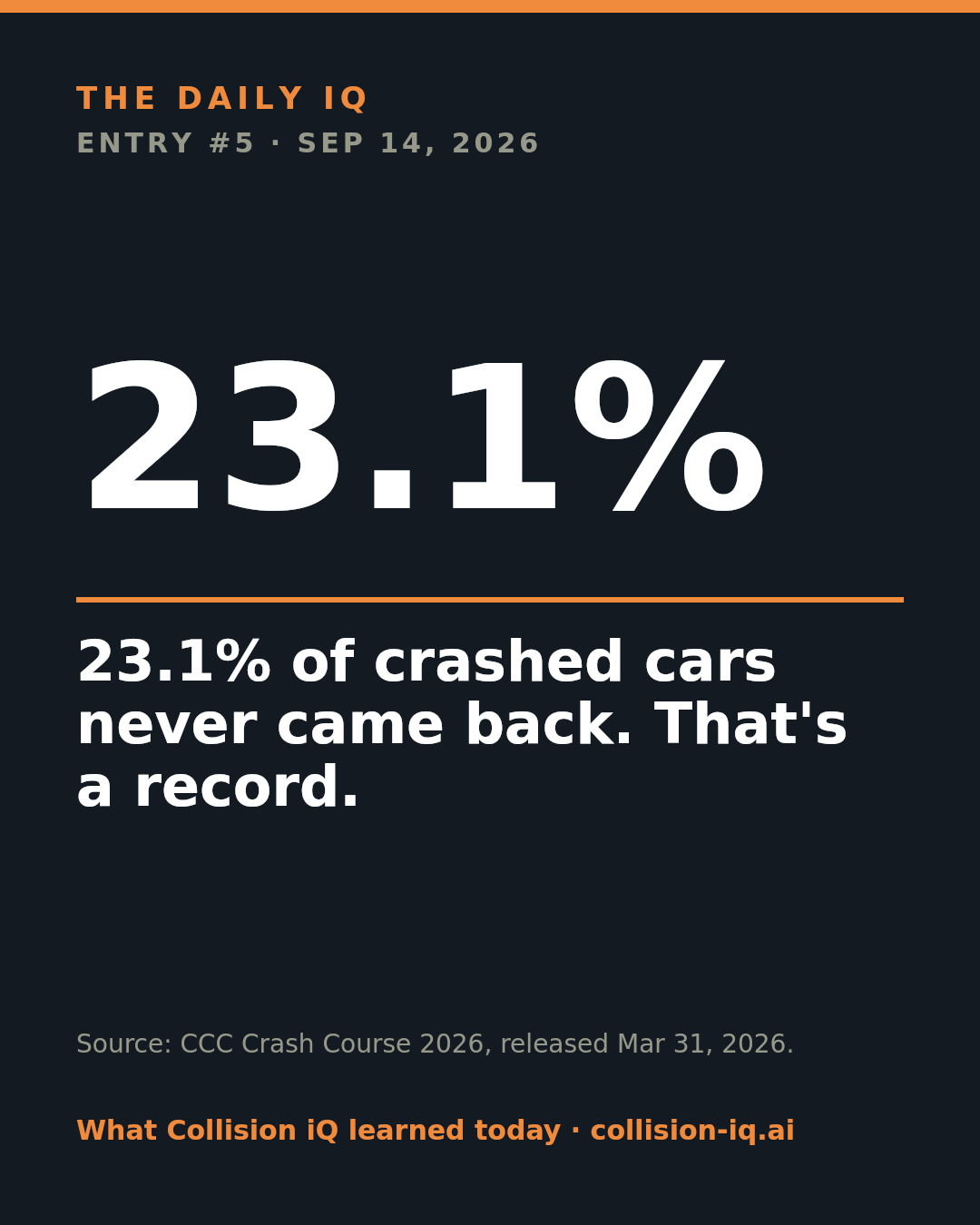
23.1% of crashed cars never came back. That's a record.

23.1%of 2025 auto claims ended in a total loss, the highest rate the industry has recorded

In 2025, 23.1% of auto claims ended in a total loss, the highest rate on record, according to CCC Intelligent Solutions' Crash Course 2026 report, released March 31, 2026. Pricier parts, sensor-packed bumpers, and softer used-car values tip the math to “total” earlier than most owners expect.

The same report counts calibrations on 28.3% of repairable estimates: the car that is still worth fixing now needs its cameras taught where to look before it leaves the shop.

Why it matters

A total-loss decision is a valuation, and a valuation is a document. When one in four claims ends there, the comparables and adjustments behind that number decide what you drive next.

How Collision iQ uses it

Filed into the knowledge base as the baseline for how often a claim becomes a valuation dispute rather than a repair dispute.

Sources — open in a new tab
#totalloss#collisionrepair#autoclaims#carinsurance#autoindustry
The Daily iQ entry 5 card: 23.1% of 2025 auto claims ended in a total loss, a record.

Share card · opens in a new tab

Entry #4Total loss & valuation

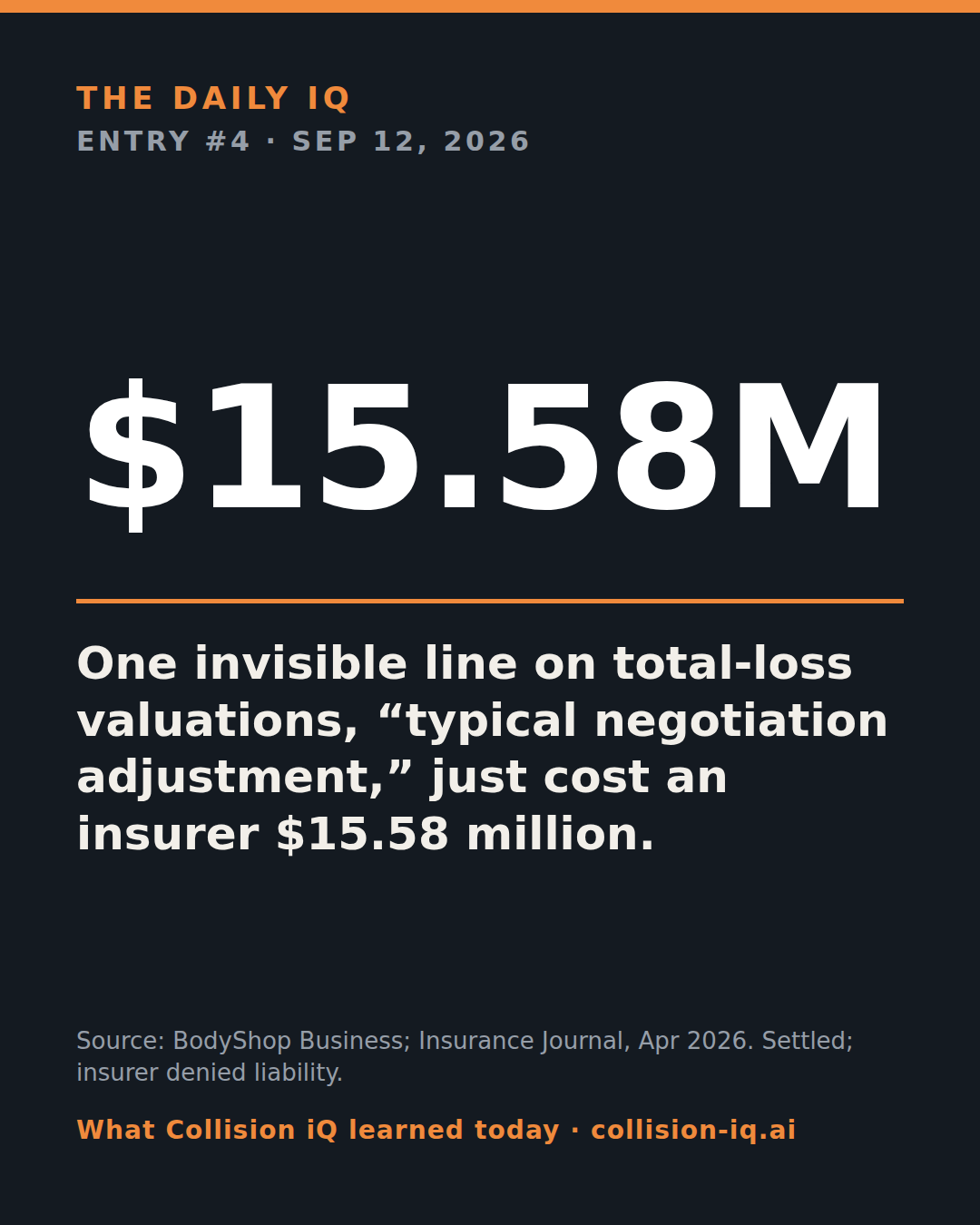
One invisible line on total-loss valuations just cost an insurer $15.58 million.

$15.58Msettlement over “typical negotiation adjustments” on Arkansas total-loss valuations

Chadwick v. State Farm (U.S. District Court, Eastern District of Arkansas) challenged valuation reports that applied a “typical negotiation adjustment,” a downward tweak to the comparable vehicles used to value totaled cars. Plaintiffs argued the adjustment had no observable market data behind it. Accepted appraisal standards require exactly that support.

State Farm settled for $15.58 million covering Arkansas first-party total-loss claims from November 2016 to October 2021. Preliminary approval was granted March 27, 2026. The insurer denied liability; the case settled and no finding of liability was made.

Why it matters

Total-loss valuations are documents, and documents can be audited. Every adjustment either has market support or it does not, and “typical negotiation” is not a market observation. If your car was totaled, read the valuation report and ask for the data behind every adjustment.

How Collision iQ uses it

This is precisely the audit Collision iQ runs on valuation and estimate documents: find the line, demand the data behind it.

#totalloss#carinsurance#autoclaims#knowyourrights#diminishedvalue
The Daily iQ entry 4 card: $15.58 million State Farm settlement over typical negotiation adjustments on total-loss valuations.

Share card · opens in a new tab

Entry #3Insurance industry data

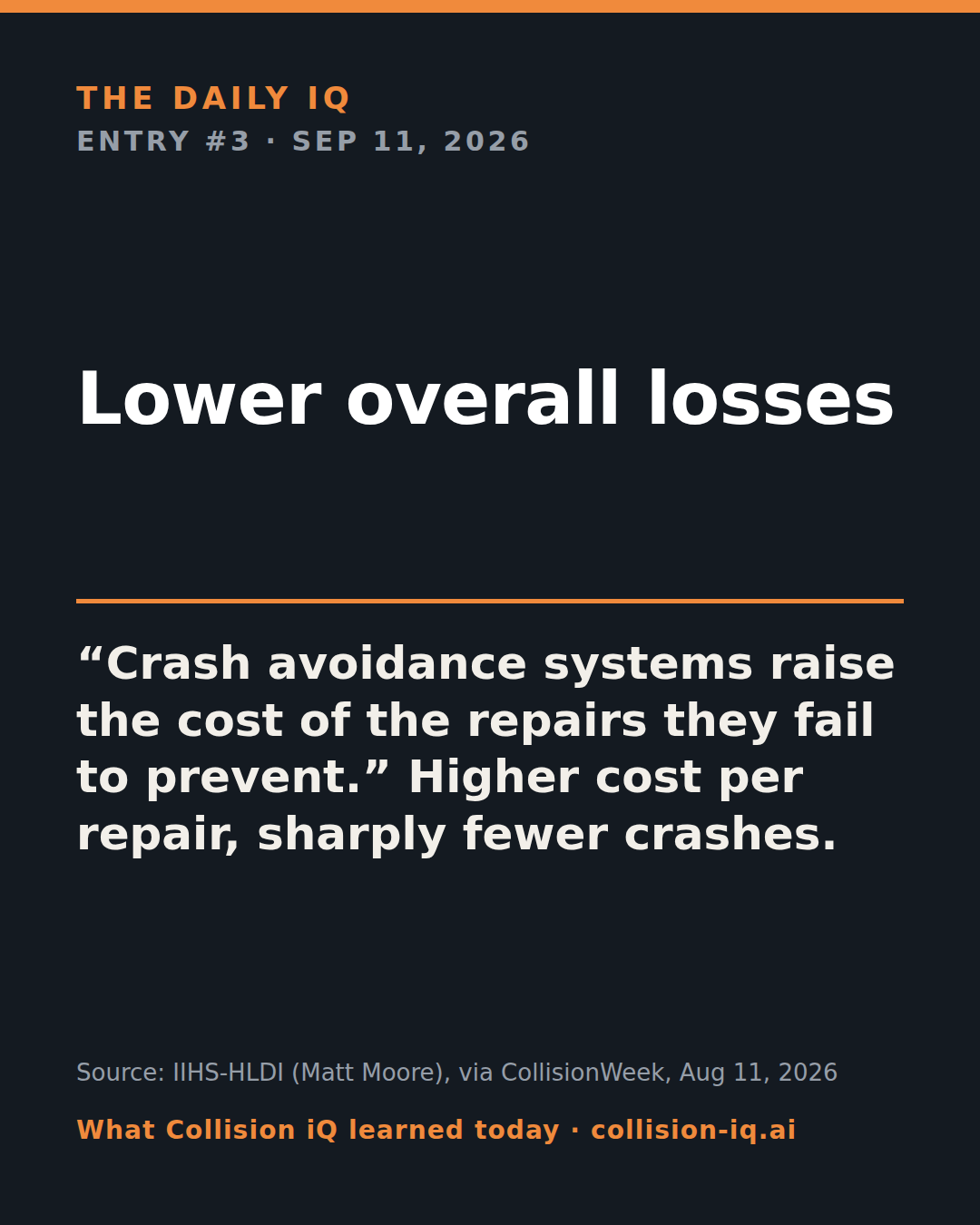
“Crash avoidance systems raise the cost of the repairs they fail to prevent.” That is the insurance industry's own research institute.

Loweroverall insurance losses on sensor-equipped vehicles, even as each repair costs more

Matt Moore, Chief Insurance Operations Officer at IIHS-HLDI, the insurance industry's own research institute, put the ADAS cost debate in one sentence: “Crash avoidance systems raise the cost of the repairs they fail to prevent.”

HLDI's data shows sensor-equipped vehicles carry higher claim severity (all those cameras and calibrations) and sharply lower claim frequency. The aggregate: lower overall insurance losses, even as individual repair bills climb.

Why it matters

Severity pressure lands on one claim file at a time, yours, while the frequency savings accrue quietly across the carrier's whole book. A complete, calibrated repair is not what is driving loss ratios. The industry's own institute says so.

How Collision iQ uses it

The platform carries this framing wherever repair-cost pushback shows up. No per-claim dollar figures were disclosed in the coverage, so none are quoted here.

#adas#carinsurance#collisionrepair#autoclaims#iihs
The Daily iQ entry 3 card: crash avoidance systems raise per-repair cost but lower overall insurance losses, per IIHS-HLDI.

Share card · opens in a new tab

Entry #2OEM position statements

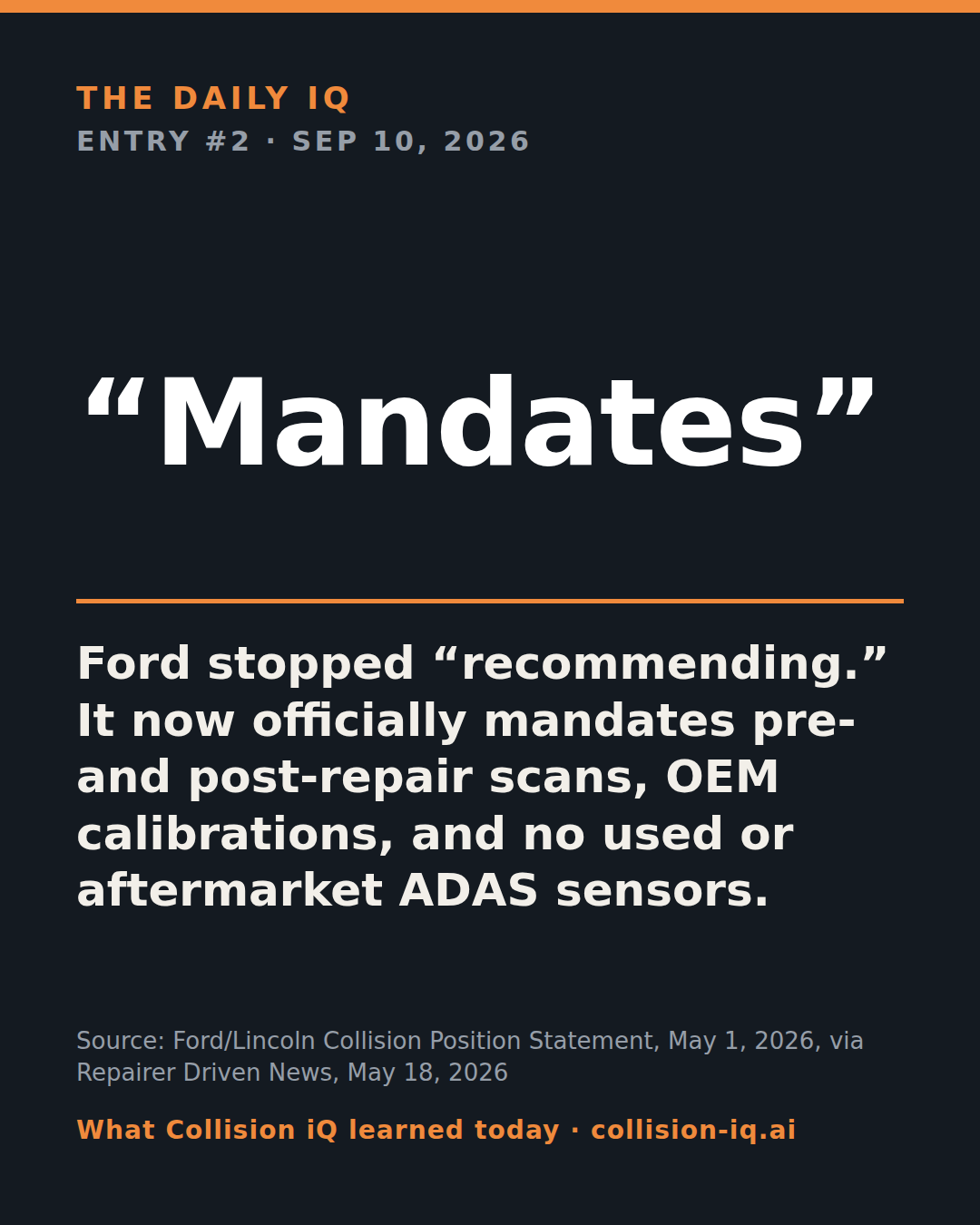
Ford stopped “recommending.” It now officially mandates.

“Mandates”the verb in Ford/Lincoln's May 1, 2026 ADAS position statement

Ford/Lincoln's updated ADAS position statement (May 1, 2026) uses language you rarely see from an OEM: Ford “officially mandates adherence to these standards to ensure the vehicle is restored to the high safety standards to which it was originally manufactured.”

What that covers: pre- and post-repair diagnostic scans on any damaged vehicle, ADAS calibrations performed to Ford's own workshop procedures, and a flat prohibition on recycled, salvaged, or aftermarket ADAS sensors. Unapproved windshields and even window tint near a camera make the list, because a distorted camera view can mean unintended braking.

Why it matters

Position statements are where repair disputes get decided on paper. When the OEM's verb is “mandates,” an adjuster's “not required” carries the burden of proof.

How Collision iQ uses it

Filed, cited, and ready to be quoted in dispute documentation. If a repair plan on a Ford gets pushback, this document is the answer key.

Sources — open in a new tab
#ford#oemprocedures#adas#collisionrepair#autoclaims
The Daily iQ entry 2 card: Ford officially mandates pre- and post-repair scans, OEM calibrations, and no used or aftermarket ADAS sensors.

Share card · opens in a new tab

Entry #1ADAS & calibration

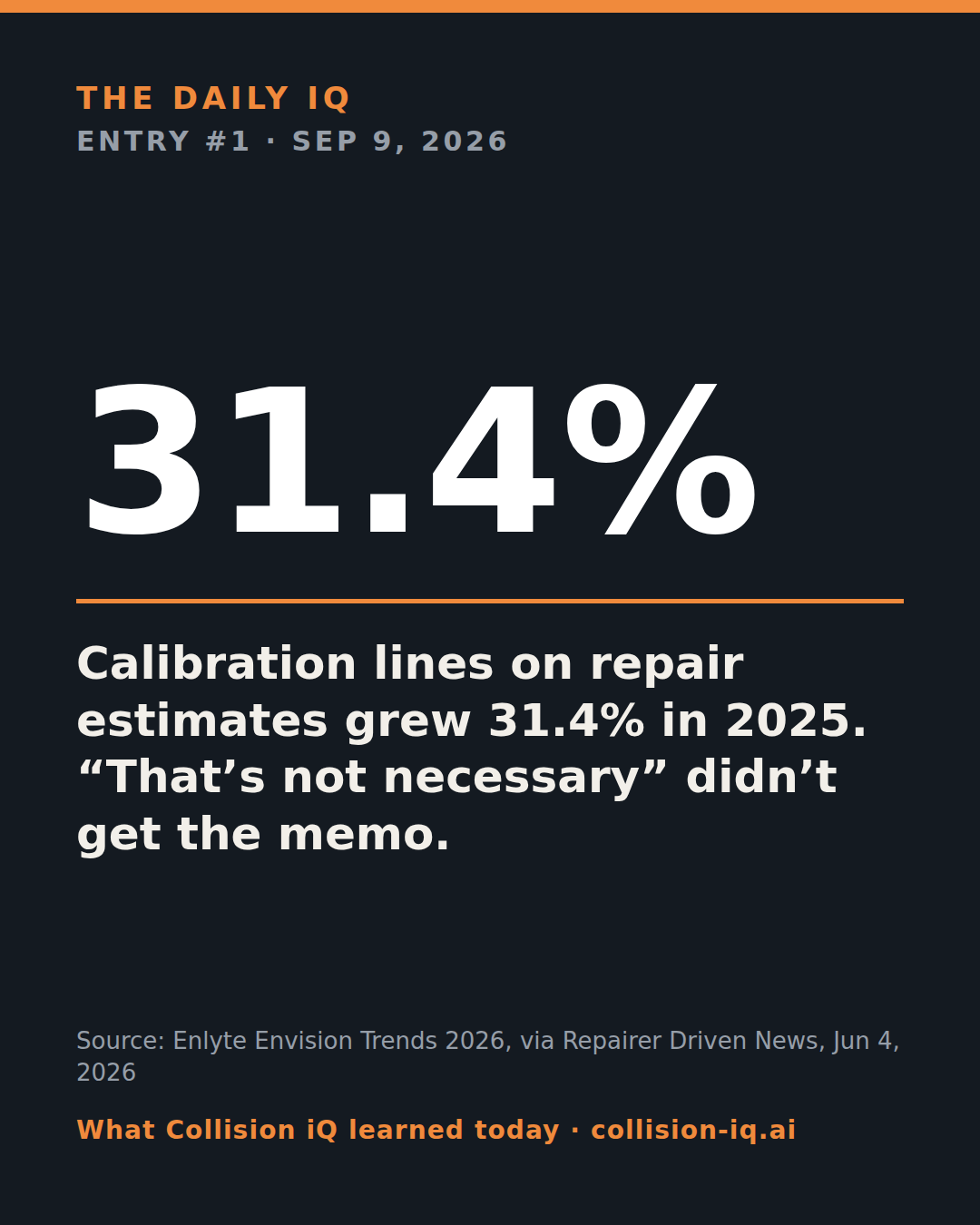
Calibration lines on repair estimates grew 31.4% in one year. “That's not necessary” didn't get the memo.

31.4%growth in estimates carrying a calibration line, 2025

Per Enlyte's Envision Trends 2026 report (Enlyte is Mitchell's parent, the company whose software processes the claims), calibration lines on repairable estimates grew 31.4% in 2025, and calibrations per repair rose about 10%.

Enlyte's own words: failure to identify and complete required calibrations “can compromise system performance and create financial and liability exposure for insurers and repairers.”

Why it matters

That is not a body shop talking. When the entity that processes the claims data says skipping calibrations is a liability exposure, “we don't pay for that” stops being a position and starts being a paper trail.

How Collision iQ uses it

Filed the day it was verified. When a calibration line is questioned in an estimate review, the platform argues from the industry's own numbers, not from vibes.

#adas#calibration#collisionrepair#autoclaims#carinsurance
The Daily iQ entry 1 card: 31.4% growth in calibration lines on estimates in 2025, per Enlyte Envision Trends 2026.

Share card · opens in a new tab